

Fall application of glyphosate is getting a closer look in Canada.
The “Keep it Clean” campaign, a joint operation of a trio of industry groups (Canola Council of Canada, Cereals Canada, and Pulse Canada), educates growers about pesticide residue limits and other guidelines, with a particular focus on export markets.
One of their main focus areas this year is fall glyphosate use. While it is not registered in Canada for pre-harvest desiccation use, glyphosate is very good at killing and then drying plants out, allowing farmers to get a jump on harvest. We cover this issue in-depth here at Managing Weeds for Healthy Kids.
As reported at Alberta Farmer, these industry groups see that “the glyphosate you use on the farm hasn’t changed– but public attitudes, at least in some quarters, have radically shifted.”
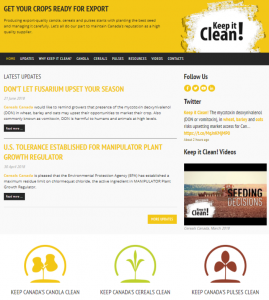
Canadian growers are urged to follow all label instructions, and the slick website for “Keep it Clean” includes these guidelines for glyphosate use on cereal crops: “…under increased scrutiny. Rigorous adherence to guidelines, including following the label, will keep this important product in our toolbox for years to come” (https://keepingitclean.ca/cereals/fall-application-of-glyphosate, accessed 6/22/18).
Cam Dahl, president of Cereals Canada, is quoted in the Alberta Farmer story saying that this “especially includes the fall application of glyphosate. Glyphosate is not registered as a desiccant [in Canada] and is not meant to be used to dry down crops.”
Canadian wheat has been under fire, particularly in European markets. In Italy, the largest farm group has aggressively campaigned against Canadian imports, convincing consumers that Canuck grain is not safe due to glyphosate residues stemming from pre-harvest applications. (Readers, thought you should know the job title of the Italian food industry rep quoted: Pasta Secretary.) As a result, Italy has purchased NO Canadian wheat since the fall of 2017, though they usually import about one million tons annually.
Hence the focus on pre-harvest glyphosate use in the “Keep it Clean” campaign this year. Canada sets a Maximum Residue Level (MRL) for agricultural products; the current MRL for wheat is 5 ppm, and was set in the mid-1990s. The initial glyphosate-wheat MRL was set at 0.1 ppm in the late 1970s.
Ironically, the glyphosate wheat MRL in Canada was raised primarily to cover the expected, higher glyphosate residues in U.S. wheat moving north across the border. While Monsanto sought, and the U.S. EPA approved Roundup label amendments allowing pre-harvest desiccation uses, Canada’s Pest Management Regulatory Agency (PMRA) apparently never did.
If any Hygeia reader can explain why, please do. We promise to revise this piece to include the explanation.
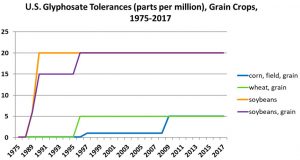
Several glyphosate tolerances were significantly raised in the 1990s to accommodate pre-harvest desiccation uses and post-emergent glyphosate applications on GMO, Roundup Ready crops. (For the details, see Part II of our Lowdown on Roundup. The big jump upward in many tolerances is clear in the graph below — allowable residues, known as tolerances here in the U.S., have been increased to allow changes in when glyphosate is applied. In a nutshell, the closer to harvest, the higher the needed tolerance, and the bigger jump in dietary exposures.
“Keep it Clean” provides specific direction to cereal crop growers about how to keep residues under export limits, such as following required pre-harvest intervals and not applying when kernel moisture content is 30% or greater. They also question why “activists” are raising health concerns about glyphosate and calling into question Canada’s “science-based regulatory process.”
Perhaps the concern of many scientists and activists has been triggered by the March 2015 classification of glyphosate as a “probable human carcinogen” by the International Agency for Research on Cancer, coupled with recent biomonitoring data that shows most people in North America are exposed to glyphosate on a near-daily basis.
Source:
Alexis Kienlen, “Glyphosate increasingly under the gun,” Alberta Farmer, June 18, 2018