
By: Rachel Benbrook and Dr. Charles Benbrook
Are bees finally going to catch a break?
Amidst lots of bad news about the decline of managed honeybees and other wild pollinators, the Seattle Times reports this week on an innovative new approach to boost pollinator health. It involves some out-of-the-box science from Paul Stamets, a mycologist from the Pacific Northwest.
Stamets is well-known among ecologists and mushroom enthusiasts for his book Mycelium Running: How Mushrooms Can Help Save the World (available via his website Fungi Perfecti), which examines how some species of fungi can remove environmental toxins in a process known as mycoremediation. To hear more on this fascinating subject, see Stamets’ stunning TED talk.
One of us (RB) has applied some of these principles in habitat restoration projects, in an approach akin to “ecology healing the environment.” Getting people excited about, and engaged in science through eco-driven restoration is one of the promising, emerging trends in the PNW.
The Seattle Times piece tells the story of how the idea that mushroom mycelium might help struggling bees came to Stamets in a “waking dream,” during which he connected the dots after remembering seeing bees buzzing around his mushroom patches. He noticed that the bees would even move wood chips out of the way to access mushroom mycelium, the underground network of branching fibers that makes up most of the biomass in fungal organisms.
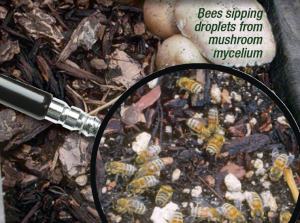
Stamets observed bees “sipping on the droplets oozing from the mycelium” and then returning to their hive. At first, he assumed they were drawn to the natural sugars present in mycelium.
But inspiration struck after a conversation with a friend about Colony Collapse Disorder (CCD), with the dreamlike realization early one morning that the bees could very well be after mycelium for it’s known antiviral properties.
So Stamets teamed up with researchers from Washington State University and the USDA to test his theory. And what they found was astounding — “bees given a small amount of his mushroom mycelia extract exhibited remarkable reductions in the presence of viruses associated with parasitic mites that have been attacking, and infecting, bee colonies for decades.” (For a more detailed look at the experimental design and findings, see our Hot Science post).
The team is planning additional experiments to better understand the reason the mycelium is helping bees fight off viruses, but one of the leading theories is that the mushroom compound is boosting the bees’ immune system. Plus, Stamets is now developing a device that will deliver his magic mushroom sauce directly to hives, which may provide a much-needed tool for beekeepers who have been facing bleak times because of CCD-driven loss of hives.
This is the kind of science we need far more of. Observation in the natural world leads to new ideas and testable hypotheses. Experiments are designed to test hypotheses. Results are recorded and analyzed, and confounding variables considered. Ideas and testable hypotheses evolve one step at a time, and sometimes go backwards when another unexpected result, or explanation surfaces. But over time science drives knowledge closer to the center of the onion.
Once in a while, a single experiment produces stunningly unexpected results, with profound real-world implications. Such work almost always triggers further exploration, as now the case with the bee-mycelium research triggered by a casual observation by Paul Stamets as he worked around his fungi farm.
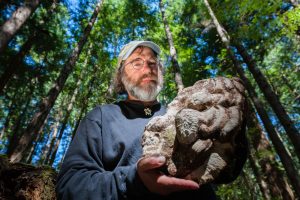
Dubbed a “renaissance mycologist” by Salon’s Linda Baker, Stamets is a well respected mushroom expert, if a bit out there in terms of theories regarding the role mushrooms play in the ecology of the world and interactions among species. His formal scientific education is limited to a Bachelor’s Degree from Evergreen State College in state of Washington.
Fortunately, Stamets never let the lack of advanced degrees fence in his mind. He was also fortunate over the years to form deep and valuable friendships with other mushroom experts more interested in solving mysteries than worshipping credentials.
This unusual tale of scientific discovery also drives home another key point — it takes fresh thinking from multiple perspectives, coupled with state-of-the-art science tools, to find new solutions to old problems.
In the world of land grant universities and the ag research establishment, “multi-disciplinary research” has been highlighted for years as the best way to solve real-world problems. But in the vast majority of cases, USDA-branded and funded multi-disciplinary research means forming teams composed of PhDs from three or four departments, not curious people who have struggled to understand the world from multiple angles and via divergent career paths.
This research happened, and produced such important results, because it was a deep hybrid tapping vastly different experiences, observations, training, and tools that go far beyond “multi-disciplinary.” For the sake of the bees, both managed and wild, we hope the research forges ahead, and remains guided by the principles that got it this far.
Source:
Evan Bush, “How the mushroom dream of a ‘long-haired hippie’ could help save the world’s bees,” Seattle Times, October 4, 2018.