
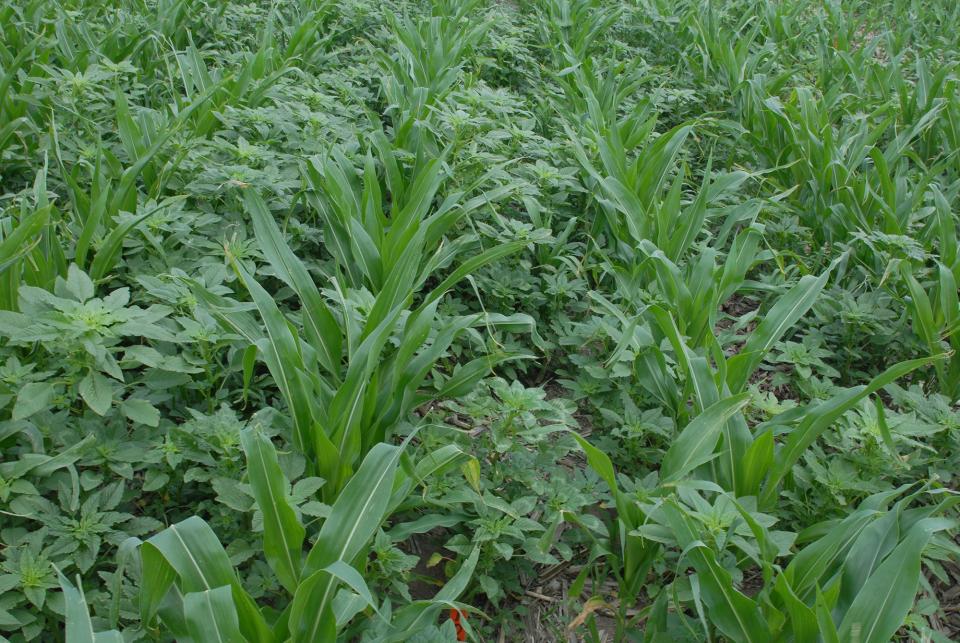
DTN staff reporter Emily Unglesbee has ably covered the dicamba-drift crisis over the past couple of years. Her latest is a detailed, three-part series on Palmer amaranth, “possibly the most aggressive weed American farmers have ever faced” (Unglesbee, 2019a).
Palmer amaranth is so scary because of its “spectacular reproductive abilities” and it’s extreme adaptability. This weed is dioecious, meaning that both male and female plants are required to breed, resulting in high genetic diversity and ability to “evolve quickly to thwart control methods, such as herbicides” (Unglesbee, 2019a).
Once fertilized, a single female plant can produce 500,000 to 1 million seeds that can survive harsh Midwestern winters and linger for years in the soil, waiting for their turn in the sun.
While a common pest in farmers’ fields for decades, particularly in the southeast, Palmer amaranth did not truly become a monster until Roundup Ready crops were introduced, along with the new practice of spraying herbicide over the top of growing fields. Farmers used more and more glyphosate, and at first it seemed like it was tough enough to battle back essentially all the weeds.
But, less than a decade after herbicide-resistant crops were introduced in 2005, the first glyphosate-resistant Palmer amaranth populations were identified in Georgia. It spread rapidly – popping up in four more states (Arkansas, North Carolina, South Carolina, Tennessee) in the next year. By 2012 it had spread across the Southeast from Kentucky to Louisiana.
Unglesbee’s special feature is broken up into three parts, each focused on how a particular region is battling herbicide-resistant Palmer amaranth. Here is a summary of the key issues faced by each group of states:
Part 1, “The Newbie States”
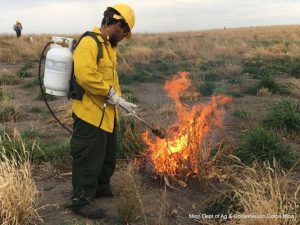
- Includes states in the upper Midwest – Iowa, Michigan, Minnesota, North Dakota, Ohio, South Dakota and Wisconsin.
- After seeing the havoc — and added costs — brought on by these weeds in the SE, weed managers and agencies in these “newbie states” are urging adherence to an aggressive, “no-tolerance” regulatory and management policy that includes “early monitoring and zero tolerance eradication” and a “beef[ed] up legal fight against Palmer amaranth” (Unglesbee, 2019a).
- Many Palmer amaranth plants moving north are already resistant to multiple herbicides, so manual control is often among the methods used to ensure eradication. Resistance to glyphosate and ALS herbicides is most common, but resistance to other herbicides has been observed as well.
Part 2, “The New Frontier States”
- These states – Texas, Oklahoma, Kansas, Nebraska, most of Missouri, Illinois, Indiana, West Virginia, Virginia, Maryland, Delaware and Pennsylvania – are located around the Southeastern core region where Palmer amaranth first developed herbicide resistance.
- Since they border the longest-lived pockets of resistance, these
 states get the worst of the worst. Many populations are resistant to multiple herbicides, such as a stand of amaranth that was recently identified in Kansas with four-way resistance to glyphosate, ALS herbicides, HPPD herbicides and triazines (i.e. atrazine) (Unglesbee, 2019b). [We also report here on a newly discovered population in Missouri that is 6-way resistant!]
 - This region grows a lot of corn, soybeans, and cotton and new dicamba and 2,4-D resistant strains now on the market, or on their way there, are raising concerns that weed resistance to these auxin herbicides is coming next, and fast. Field testing at the University of Maryland has documented up to 50% resistance to 2,4-D in Palmer amaranth already.
- “The chemistry I fear for the most is the combination of stacked herbicides, like glyphosate and 2,4-D and glyphosate and dicamba,” says University of Maryland plant biologist Wendy Peer, “I believe that this combination will quickly select for resistance to these two herbicides, which may already be present in the state” (Unglesbee, 2019b).
- Weed scientists are looking at alternative strategies to control resistant weeds, such as integrating cover crops and using manual removal.
Part 3, “The Veteran States”
- These are the core Southeastern states (Arkansas, Alabama, Georgia, Kentucky, Louisiana, Mississippi, North Carolina, South Carolina, Tennessee, and part of Missouri) that have been ground zero for herbicide-resistant amaranth. The first resistant plants were found 14 years ago. Today, the regional weed control strategy is focused on controlling this monster weed.
- While many farmers have adapted to the new normal and “diversified their weed management tactics [to] save farms once overrun by resistant pigweed” (Unglesbee, 2019c), the number and type of resistant varieties of amaranth continues to spread.
- An aggressive approach to education and control, and a zero-tolerance policy for any farms that produce weed seed, have allowed these states to generally hold their ground against herbicide-resistant Palmer amaranth. But, it’s been difficult and costly for farmers to adjust to the reality that “the chemical-only approach to weed control is gone and is never coming back” (Unglesbee, 2019c).
- “We can’t win with just herbicides,” says the University of Georgia’s Stanley Culpepper. Instead, extension agents recommend “an aggressive prescription of crop rotation, chemical rotation, overlapping pre- and post-planting residual herbicides, timely applications of chemicals and hand removal of weed escapes” (Unglesbee, 2019c).
- Like other states, these veterans are concerned about emerging resistance to glufosinate, 2,4-D, and dicamba as the next-gen, multiple-herbicide-resistant crop varieties come onto the market. Since glyphosate is off the table, farmers use more and more of these other herbicides, shifting selection pressure for resistance, not reducing it.
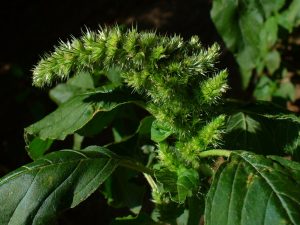
To top off these regional concerns, Unglesbee also raises the specter of “metabolic resistance.” Weed scientists in Arkansas are “pretty confident” they have some populations of Palmer amaranth that already have metabolic resistance.
What is metabolic resistance and how does it differ from other resistance mechanisms?
Most resistant weeds are undamaged by herbicides because of a change to their genetics that blocks the action of a specific chemical. Metabolic resistance, on the other hand, means that a weed “learns” how to quickly break down, or metabolize, an herbicide’s active ingredient so that it does little to no harm. Once a weed figures out how to metabolize one herbicide, it can quickly become resistance to multiple different modes of action herbicides.
In other words, the weeds are getting smarter and tougher, and in many of the same ways insects have to several resistance-prone, persistent insecticides.
Unglebee’s three part series paints a vivid picture of how this monster weed is affecting farmers around the country. As the latest national map shows (image below), Palmer amaranth has spread almost throughout the entire continental U.S. in less than 15 years.
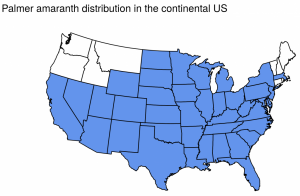
Many of these populations are already herbicide-resistant, others are on their way towards developing this adaptation.
While herbicide-resistant Palmer amaranth is obviously a thorn in the side of farmers in many key agricultural regions of the country, it is important to recognize that in the places where it has been the biggest challenge, it has forced farmers to adapt in some positive ways.
Today, farmers in the Southeast are returning to integrated weed management systems, a mainstay of sustainable agriculture that is now getting new attention as herbicide resistance has become more prevalent.
Necessity breeds invention, and resistant weeds like Palmer amaranth have forced farmers to pull out a different mix of tools from their toolbox, rather than just loading up the sprayer and hoping for the best. Maybe, in the long run, the saga of Palmer amaranth will begin the long-overdue transition back to multi-tactic, integrated weed management systems and actually reduce overall reliance on herbicides.
Sources:
Unglesbee, Emily (2019a), “The State of the Pigweed – 1, Palmer Amaranth’s American Roadtrip: The Newbie States,” The Progressive Farmer, Date published: 01/28/2019, Date accessed: 02/01/2019.
Unglesbee, Emily (2019b), “The State of the Pigweed – 2, Palmer Amaranth’s American Roadtrip: The New Frontier States,” The Progressive Farmer, Date published: 01/29/2019, Date accessed: 02/01/2019.
Unglesbee, Emily (2019c), “The State of the Pigweed – 3, Palmer Amaranth’s American Roadtrip: The Veteran States,” The Progressive Farmer, Date published: 01/30/2019, Date accessed: 02/01/2019.