
Hygeia AnalyticsLogo

Menu

Skip to content
  • Home
  • About Hygeia
    Analytics
    • Dynamic Presentations
    • Keywords and Site Map
    • Hygeia Analytics – Who We Are
    • Why Hygeia?
    • Funding and “Sound Science”
    • Acronyms and Glossary
    • Sign-Up for Updates
  • Nutrition
    • Introduction and Nutrition 101
      • Good Fat Bad Fat
      • Fatty Acids
        • Primer on the Fatty Acids in Milk
      • Impact of Livestock Feeding
    • Antioxidants
      • Organic Farming Elevates Antioxidants
      • Maximizing Antioxidant Intake
    • Organic vs. Conventional Foods
      • Milk and Dairy Products
        • 2018 Grassmilk Paper
        • PLOS ONE Study
        • Dairy Meta-Analysis
      • Multi Food Meta-Analyses
        • Meat Products
        • Plant-Based Foods
        • Smith-Spangler et al.
        • Dangour et al.
        • The Organic Center Report
      • Food Specific Comparisons
        • General
        • Fruits and Vegetables
        • Wine and Wine Grapes
    • Considering Nutritional Quality
      • Impact of Genetics and Production Systems
      • New Tool for Food Security
      • Transforming Jane Doe’s Diet
      • Nutritional Quality Index
    • Nutrient Decline
    • Other Choices and Challenges
      • Human Health
      • Dietary Choices
  • Pesticides
    • Usage
      • Pesticide Use Data Sources
        • Pesticide Use Indicators
      • PUDS – The Pesticide Use Data System
    • Dietary Risks
      • The Dietary Risk Index (DRI)
    • Risk Assessment and Regulation
      • Food Quality Protection Act (FQPA)
      • Glyphosate/Roundup Case Study
      • The Lowdown on Roundup
      • Does Glyphosate/Roundup Cause Cancer?
      • 2019 Glyphosate Genotoxicity Paper
    • Impacts of GE on Pesticide Use
    • Environmental, Human Health, and Other Impacts of Pesticides
  • Ag Biotech
    • Key Historical Documents – Donald Duvick
    • Key Historical Documents – Arpad Pusztai
    • Herbicide Resistant Crops
    • Weed Resistance
    • Bt Transgenic Crops
    • Resistant Insects
    • Health Risks and Safety Assessments
    • Regulation of GE Crop Technology
    • Marketing, Economics, and Public Relations
    • Patenting and Intellectual Property Issues
    • Labeling
  • Other Issues
    • Animal Products
    • The Future of Food
    • Global Food Security
    • Natural Resources and Climate Change
    • Alternatives to Industrial Ag
    • Policy and Politics
    • Scientific Integrity
    • Soil Health
    • Yields
  • Recent Posts
    • Hot Science
    • In The News
    • Hygeia’s Blog
  • Special
    Coverage
    • Organic Apples in Washington State
    • Dicamba Drift Crisis
    • Organic Food Consumption Lowers Cancer Risk
    • Organic Integrity

New Science Explores the “Irrigation Paradox”

Posted on September 5, 2018 in Hot Science | 979 Views

A new study published in Science makes some progress untangling the roots of what’s known as the “irrigation paradox.”

Water is precious, and irrigating crops uses a whole lot of it – accounting for 70% of global fesh water extractions.  And, in many key agricultural regions, water availability is the key limiting factor to crop yields, and elsewhere, access to clean water is among the most pressing public health challenges.

As part of water conservation efforts, inspired in part by a changing climate, farmers and regulators have made strides in irrigation efficiency.  The mantra has been to maximize the “crop per drop,” and minimize evaporation, runoff, and other water losses.

However, the puzzling trend is that as infrastructure and behavior changes lead to improvements in irrigation efficiency, overall water use does not, in fact, go down.  A research team including scientists from around the globe, including Australia, China, Egypt, the US, and the UK took a closer look at the “Irrigation Paradox” — increases in water use efficiency “rarely delivers the presumed public-good benefits of increased water availability.”

What seems to happen instead is that water saved by efficiency improvements is used elsewhere on the farm or in farming regions. One reason is that farmers tend to shift towards more water-intensive, higher-value crops, or use the additional water to achieve higher yields or otherwise improve their harvest (e.g., more pounds of milk or meat per acre).

The authors articulate two key insights that contribute to this problem – the first being that irrigation systems are generally managed not for water availability, but to “maximize irrigated crop production.”

The second insight is related to how irrigators perceive the “lost” water that runs through irrigation pipes and systems, but is not consumed by crops.  Many farmers feel that this is a lost resource, but the authors point out that this water reenters the water supply via surface flows or groundwater recharge, and is typically recovered and used elsewhere at the watershed or basin level.

In other words, few drops of water are truly “lost,” they just move through the system and have value downstream somewhere to another farmer, a community, or perhaps fish or frogs.
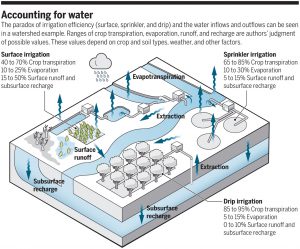
This informative graphic from the Science magazine piece illustrates the accounting of water in a watershed or basin, and impact of different irrigation types. Note how water flows back into the system after irrigation, although the efficiency of the different systems varies. Source: Grafton et al., 2018

Getting a better handle on water inflows/outflows is one of the steps the authors recommend for policy makers and resource managers.  Others include:

  • Measuring water use based on net extractions, which include an estimate of return flows into the water supply,
  • Developing comprehensive measurements of costs and benefits of different water uses, and
  • Studying the behavior of irrigators to understand how increased efficiency impacts choices on the farm.

We can’t grow food without water, so untangling our complicated relationship with this essential resource is an important part of adapting to changing societal norms, not to mention the weather changes expected in the years to come.

Source:

R. Q. Grafton, J. Williams, C. J. Perry, F. Molle, C. Ringler, P. Steduto, B. Udall, S. A. Wheeler, Y. Wang, D. Garrick, R. G. Allen, “The paradox of irrigation efficiency,” Science, 24 Aug 2018, Vol. 361, Issue 6404, DOI: 10.1126/science.aat9314.


Posted in Hot Science | Tagged Climate Change, Future of Food, Natural Resources, Yield

Related Posts

FAQs re Biden-Harris Ag and EPA Transition Priorities→

Neonic Seed Treatments in the (Science) News→

So What About the Integrity of the U.S. Organic Grain Supply?→

This Monster Dose of Innovation is Reason for Hope→

Are We Ready for Grassland 2.0?→

Early-Life Insecticide Exposure Compromises Brain Development in Bees→

Math Mythology and More of the Same: USDA’s Sustainability Plan→

A Closer Look at InsideClimate News’ Award-Winning Series on How American Farm Policy is Deeply Rooted in Resistance to Climate Change Adaptation→

©2016 Hygeia-Analytics.com. All Rights Reserved.

Menu