
Hygeia AnalyticsLogo

Menu

Skip to content
  • Home
  • About Hygeia
    Analytics
    • Dynamic Presentations
    • Keywords and Site Map
    • Hygeia Analytics – Who We Are
    • Why Hygeia?
    • Funding and “Sound Science”
    • Acronyms and Glossary
    • Sign-Up for Updates
  • Nutrition
    • Introduction and Nutrition 101
      • Good Fat Bad Fat
      • Fatty Acids
        • Primer on the Fatty Acids in Milk
      • Impact of Livestock Feeding
    • Antioxidants
      • Organic Farming Elevates Antioxidants
      • Maximizing Antioxidant Intake
    • Organic vs. Conventional Foods
      • Milk and Dairy Products
        • 2018 Grassmilk Paper
        • PLOS ONE Study
        • Dairy Meta-Analysis
      • Multi Food Meta-Analyses
        • Meat Products
        • Plant-Based Foods
        • Smith-Spangler et al.
        • Dangour et al.
        • The Organic Center Report
      • Food Specific Comparisons
        • General
        • Fruits and Vegetables
        • Wine and Wine Grapes
    • Considering Nutritional Quality
      • Impact of Genetics and Production Systems
      • New Tool for Food Security
      • Transforming Jane Doe’s Diet
      • Nutritional Quality Index
    • Nutrient Decline
    • Other Choices and Challenges
      • Human Health
      • Dietary Choices
  • Pesticides
    • Usage
      • Pesticide Use Data Sources
        • Pesticide Use Indicators
      • PUDS – The Pesticide Use Data System
    • Dietary Risks
      • The Dietary Risk Index (DRI)
    • Risk Assessment and Regulation
      • Food Quality Protection Act (FQPA)
      • Glyphosate/Roundup Case Study
      • The Lowdown on Roundup
      • Does Glyphosate/Roundup Cause Cancer?
      • 2019 Glyphosate Genotoxicity Paper
    • Impacts of GE on Pesticide Use
    • Environmental, Human Health, and Other Impacts of Pesticides
  • Ag Biotech
    • Key Historical Documents – Donald Duvick
    • Key Historical Documents – Arpad Pusztai
    • Herbicide Resistant Crops
    • Weed Resistance
    • Bt Transgenic Crops
    • Resistant Insects
    • Health Risks and Safety Assessments
    • Regulation of GE Crop Technology
    • Marketing, Economics, and Public Relations
    • Patenting and Intellectual Property Issues
    • Labeling
  • Other Issues
    • Animal Products
    • The Future of Food
    • Global Food Security
    • Natural Resources and Climate Change
    • Alternatives to Industrial Ag
    • Policy and Politics
    • Scientific Integrity
    • Soil Health
    • Yields
  • Recent Posts
    • Hot Science
    • In The News
    • Hygeia’s Blog
  • Special
    Coverage
    • Organic Apples in Washington State
    • Dicamba Drift Crisis
    • Organic Food Consumption Lowers Cancer Risk
    • Organic Integrity

New Meta-Analysis: Extensive Phenotypic Differences Between GMO and non-GMO in Cultivated Plants

Posted on May 30, 2018 in GMOs, Hot Science | 639 Views

The myth of “substantial equivalence” between GMOs and non-GE crops (called “isolines”) takes yet another hard science hit.

A team of researchers in Mexico City has published their meta-analysis of genetic data on rice, canola, maize, sunflower, and pumpkin.  They looked at wild, GMO, and non-GMO cultivated varieties of these five crops, analyzing phenotypic change.

The phenotype of a crop is defined by a set of characteristics expressed by the crop’s genetic code (DNA).  In theory, genetically engineered plants will show phenotypic changes only linked to the targeted traits scientists added to the GMO and hope to express.  For example, a corn plant engineered to express the Bt toxin should not be different from normal corn in other ways, as has been reported here on Hygeia.

However, genetics are complicated and unintended consequences often occur. Of the five crops analyzed in this study, maize, pumpkin and rice showed the most variation between GMO and non-GMO cultivars.  These three crops demonstrated wide variation for traits related to days to flowering, number of seeds/fruit, plant height, and pollen viability.  In fact, the researchers report that for non-GMO and GMO cultivars of maize, pumpkin and rice, “almost all analyzed traits differ statistically.”
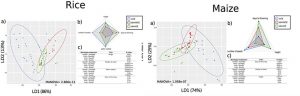
According to the biotech industry PR, genetic engineering is “precise” and only affects the target genes. If that was the case, the researchers would have seen significant overlap between the non-GMO varieties (green shapes), GMO cultivars (red shapes), and the ancestral, or wild varieties (blue shapes).

This latest report of “unintended consequences” from the genetic engineering process again raises questions about the official USDA policy claiming that other that GMOs are “substantial equivalent” or  “functionally equivalent” to the original, non-GE isoline.  We report on this and other concerns about GMOs elsewhere on Hygeia.

Source:

Alejandra Hernández-Terán, Ana Wegier, Mariana Benítez, Rafael Lira, and Anna E. Esclaante, “Domesticated, Genetically Engineered, and Wild Plant Relatives Exhibit Unintended Phenotypic Differences: A Comparative Meta-Analysis Profiling Rice, Canola, Maize, Sunflower, and Pumpkin,” Plant Science, December 5, 2017.

Posted in GMOs, Hot Science | Tagged GE Impacts

Related Posts

This Monster Dose of Innovation is Reason for Hope→

New Iowa Centric Verse of the Dicamba Blues→

Guest Blog: A Welcomed Dose of Straight Talk — “Making Liars of Proponents and Fools of Enablers”→

Back to the Future for Plant Breeders in Africa? A Fresh Look at One Scientist’s Dilemma→

Secretary Purdue Needs a Weed-Management 101 Briefing→

More Evidence that Herbicides Impact the Gut Microbiome, This Time It’s 2,4-D in Mice→

Guest Blog: A Dicamba Update from the Save Our Crops Coalition→

Dealing With Roundup’s Mammoth — and Growing — Ecological Footprint→

©2016 Hygeia-Analytics.com. All Rights Reserved.

Menu