

The February 2017 issue of Environmental Health Perspectives contains an important open access research paper on the human health effects of neonicotinoid insecticides (nicotinyls for short). The work was carried out by a team led by Dr. Melissa Perry of George Washington University. The issue also includes an accompanying news report by Nate Seltenrich.
Dr. Perry and her team wondered what was known about neonicotinyl health effects, given that this class of insecticides was introduced to reduce risks arising from organophosphate and carbamate insecticides. The team reviewed the global, peer-reviewed database on neonicotinyl human health studies and found only eight studies that met minimal quality standards, and fewer than a half-dozen relevant to assessment of general population risks from chronic exposures through the diet.
The four general-population studies did uncover statistically significant evidence that nicotinyl exposures increase the risk of developmental and neurological impairment including anencephaly (Adjusted Odds Ratio = 2.9), autism (AOR = 1.3), and cluster of neurological disorders including memory loss and finger tremors (AOR = 14).
These findings, and the lack of high-quality, modern studies done by independent scientists, is worrisome because nearly all Americans are exposed on a daily basis to one-four residues of nicotinyl insecticides. For more on the implications of this paper, check out this Hygeia’s Blog piece.
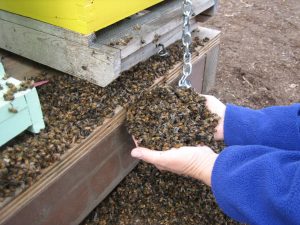
This is the class of insecticides also implicated in honey bee Colony Collapse Disorder, and is also by far the most heavily used class of insecticides worldwide. In the U.S., most acres of most fruit and vegetable crops are treated with one to three nicotinyls. The seeds used to plant most row crops (e.g., corn, soybeans, cotton) and grains are coated with a nicotinyl seed treatment, which moves through the roots up into plants, including the part of the plant harvested and used for food. See more information on pesticide impacts to pollinators here.
Residues of the neonicotinyl insecticides imidacloprid, acetamiprid, thiamethoxam, and clothianindin are commonly found in conventionally grown fruits and vegetables, and in many samples, residues of 2 different nicotinyls are detected.
In 2015 testing by the USDA’s Pesticide Data Program, 9,831 samples of conventional food were tested, and 16,116 residues of pesticides and/or their metabolites or isomers were found (nearly two per sample). Over 4,000, or 25%, were residues of nicotinyl insecticides, by far the most from any family of pesticide chemistry.
The greatest concern from our daily dose of nicotinyls is over prenatal and developmental impacts on infants and children, which can occur following even very-low-dose exposures that disrupt or block gene expression as the child’s neurological and other organ systems get “wired.”
The current toxicological basis for EPA regulation of nicotinyls is very thin in terms of state-of-the-art assays capable of detecting endocrine-related disruption at very low doses. Fortunately, the cost of these short-term studies is steadily declining and they can be completed in months, but to date, there virtually no support for independent science on these, or most other, high-use pesticides.
In the meantime, a significant share of children are now exposed daily via diet and/or drinking water, from before birth through their adult years, to mixtures of nicotinyls, herbicides (glyphosate, atrazine, 2-4, D and dicamba), and fungicides (a long list).
Perhaps the time has come for the government to fund independent scientists so they can begin testing the most common combinations at very low doses, in studies properly designed to detect the metabolic markings of progression to disease. If this is not done, the gamble goes on over the future health trajectory of the next generation, which happens to include my grandkids.
Sources:
Andria M. Cimino, Abee L. Boyles, Kristina A. Thayer, and Melissa J. Perry, “Effects of Neonicotinoid Pesticide Exposure on Human Health: A Systematic Review,” Environmental Health Perspectives, Vol. 125, Number 2, February 2017
Nate Seltenrich, “Catching Up with Popular Pesticides: More Human Health Studies Are Needed on Neonicotinoids,” Environmental Health Perspectives, Vol. 125, Number 2, February 2017