
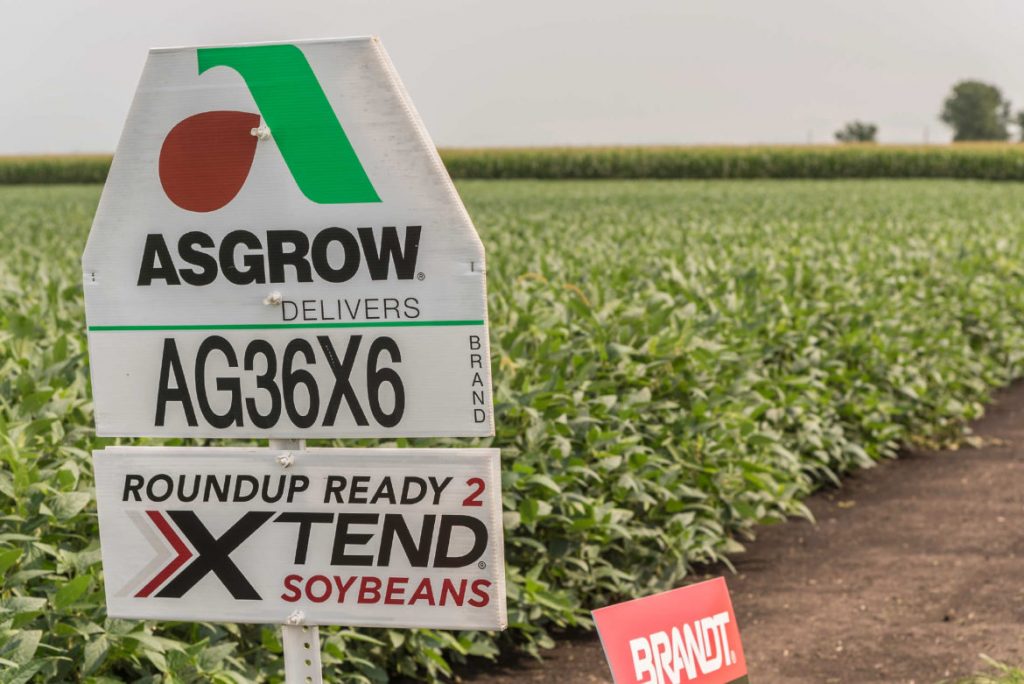
According to all reports, dicamba volatilization, drift, and crop damage has markedly worsened in 2020 in Iowa, as many expected it would. Bob Hartzler, a widely respected, experienced weed scientist at Iowa State, has published a July 8, 2020 blog entitled “Dicamba 2020: What went wrong in Iowa?” For the story of how we got here, see our extensive special coverage on the dicamba drift crisis.
In short, a lot. Hartzler describes the scope of damage and some unexpected reasons why it is occurring. The piece begins by acknowledging:
“There is no question that dicamba injury across the Iowa landscape in 2020 is the most extensive it has been since the introduction of dicamba in the 1960s. ISUEO field agronomists and commercial agronomists in several areas of the state report nearly all non-dicamba resistant soybean are showing symptoms characteristic of dicamba, and in many fields the injury is fence row to fence row. This is not the type of injury we have observed in the past; it’s at a landscape level.”
He goes on to explain four factors that have made the 2020 dicamba drift and crop/tree damage year the worst yet in Iowa:
“The court decision. On June 3rd, the US Court of Appeals cancelled registration of dicamba products used on soybean, creating turmoil in soybean producing regions across the US…” leading to uncertainty among farmers over when they could apply dicamba herbicides they had paid for, to treat fields planted to more costly soybean seed containing the dicamba-resistance trait. In short, uncertainty on the farm over the 9th Circuit Court’s actions altered the timing of dicamba applications in ways that impaired efficacy and likely contributed to drift and damage.
“Environmental conditions. The 2020 growing season got off to a great start with a record pace for planting both corn and soybean across most of the state. This resulted in soybean reaching susceptible stages when early applications of dicamba were being made to corn, and in many areas there was an overlap between dicamba being sprayed on corn and soybean – these two things do not coincide so closely in many years”, and …”weather conditions offered few days ideal for applying herbicides…” This led to very heavy spraying in the few windows when weather conditions allowed, exacerbating drift and damage episodes.
“Use on corn. Dicamba use in corn has increased in recent years due to the spread of waterhemp biotypes resistant to Group 5 (atrazine), Group 9 (glyphosate) and Group 27 herbicides (HPPD inhibitors). Several agronomists have reported dicamba being used for late postemergence applications after earlier treatments performed poorly.”
Rates. “In addition to more acres being sprayed with dicamba, the rates of dicamba have increased for multiple reasons…”
Hartzler then makes a statement everyone concerned about the future of corn and soybean production in the Midwest should take very seriously —
“Nearly everyone in agriculture recognizes the widespread injury to soybean this year is not acceptable.”
“Atmospheric loading” is a major reason why. Hartzler explains that atmospheric loading is brought about by “…so much dicamba moving into the atmosphere that it is difficult, if not impossible, to identify the specific application that resulted in injury to a field.”
What Comes Next?
Between the election and inaugural, the Trump Admin-led EPA will almost surely find a way to grant new registrations for slightly altered dicamba formulations. This EPA action will assure a repeat of use, drift, and damage levels in crop year 2021 that are similar to 2020.
Early in 2021, the 9th Circuit Court will be petitioned to review and vacate the new registrations, a process that could cloud the 2021 crop season with uncertainty even more disruptive than in 2020.
Another crucial set of decisions will occur early in 2021, when pesticide-seed companies decide how much of the soybean, cotton, and corn seed supply for 2022 will contain the dicamba-resistance gene.
Or, alternatively, the companies could decide to: (a) not remove the dicamba-resistance gene immediately from their plant breeding lines, but also (b) not charge a premium for it, nor allow over-the-top dicamba applications on it. These actions would end most legal applications of dicamba over-the-top on soybeans and cotton, but would likely create a mammoth enforcement challenge to curtail off-label sprays.
Hartzler asserts correctly in his blog’s closing paragraph —
“Herbicides will continue to be the backbone of agricultural weed management for the foreseeable future, but they need to be used as part of an integrated management program in order to protect their effectiveness and reduce negative impacts to the environment.” (See more on this kind of farming here).
One other point deserves more attention — the farm-level costs of failing corn-soybean weed management systems in Iowa are driving the cost of corn and soybean production well above the costs to grow these two crops in many other countries around the world.
In short, weed management problems brought on by excessive reliance on herbicides overall, and glyphosate in particular, could soon price Iowa row crop farmers out of world markets. The path to solutions remains obscure and will be very difficult to implement in the current political and cultural environment.
Sources:
Bob Hartzler; “Dicamba 2020: What went wrong in Iowa?;” Iowa State University Extension and Outreach Blog; Date Posted: July 8, 2020, Date Accessed: July 8, 2020.