

Genetically engineered (GE) corn and cotton expressing Bt toxins for insect control came on the market in 1996. The most contentious public policy and regulatory issue prior to approval was whether and how the biotech-seed companies should prevent the emergence and spread of insects newly resistant to Bt toxins.
For more on the debate over resistance management in the 1990-1996 period, see this just-published paper in Current Environmental Health Reports.
Within just a few years, GE-Bt corn and cotton gained substantial market share. Mandatory, resistant-management provisions imposed by the EPA, and agreed to by industry, seemed to be working. By the mid-2000s, the industry began arguing to EPA that the resistance-management requirements were overkill and unjustifiably costly, because the latest Bt corn and cotton varieties expressed two different Bt toxins (to help prevent resistance and boost efficacy), and usually were also Roundup Ready.
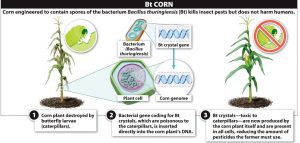
These new varieties ushered in the current era of “stacked,” multiple-trait Bt corn and Bt cotton varieties, and rested on logic memorably set forth in the famous Tennessee Ernie Ford song, “16 Tons.”
“You load sixteen tons, what do you get?
Another day older and deeper in debt
Saint Peter, don’t you call me ’cause I can’t go
I owe my soul to the company store”
“If you see me comin’, better step aside
A lotta men didn’t, a lotta men died
One fist of iron, the other of steel
If the right one don’t get you, then the left one will”
Full lyrics here.
Since 2010, a majority of new Bt corn and cotton varieties have expressed three or more different Bt toxins, and SmartStax, a GE-Bt corn event developed by Monsanto, expresses six.
Prior to approval, the industry claimed, and regulators concurred, that the Bt toxins in GE-Bt crops posed no human health risks, mostly because the toxins break down quickly in the acidic conditions in mammalian stomachs and GI tracts.
Once this notion was generally accepted, there seemed no need or reason to conduct further food safety studies, so the industry marched on in developing dozens of different corn and cotton crops engineered to express varying combinations of Bt toxins.
There was just a little, generally shallow and short-term food safety research done on each new Bt event as a stand alone GE trait, prior to government approval.
And then in what will likely emerge as one of the greatest leaps of faith in the GE crop era, the industry convinced regulators that if each Bt toxin is safe by itself, there is no reason to worry about a crop expressing two of them, or three, or six. Ever read the contraindications on a drug bottle?
If a Little is Good, More is Better, Right?
The quantity of Bt toxins produced per acre by GE-Bt crops doubled in the first few years of adoption, and then doubled again between 2005 and 2015. On average, the quantity of Bt toxins expressed per acre has kept on rising as multi-trait, stacked varieties became the norm, with no end in sight.
Today, on average, each acre of Bt corn expresses around 2 pounds of Bt toxins. The residues in the harvested corn are obviously substantial as a result, especially when compared to conventional insecticide residue levels.
But heck, if they just break down and disappear, who cares?
The almost complete lack of public funding in the U.S. for Bt-crop food safety research by independent scientists has allowed a myth to go unchallenged — that the science is settled, there is no reason to worry about Bt crop impacts on human and animal health.
Fortunately, a few scientists in other countries have been able to cobble together funds to apply state-of-the-art science to contemporary GE crop food safety issues. E.g., the Australian team that just published a paper reporting worrisome damage to the stomach lining of rats fed a triple-stack GE corn, expressing two Bt toxins and a Roundup Ready gene.
The paper raises alarm and more questions. Too bad there is little chance any of the badly needed, followup studies will be done in the U.S., including a repeat of the Australian rat study with more animals in each treatment and the control group, additional GE-Bt traits, additional dose levels, and a fuller suite of advanced histopathological methods.
Source:
Charles Benbrook, “Why Regulators Lost Track and Control of Pesticide Risks: Lessons From the Case of Glyphosate-Based Herbicides and Genetically Engineered-Crop Technology,” Current Environmental Health Report, 2018.