

Hygeia AnalyticsLogo

Menu

Skip to content
  • Home
  • About Hygeia
    Analytics
    • Dynamic Presentations
    • Keywords and Site Map
    • Hygeia Analytics – Who We Are
    • Why Hygeia?
    • Funding and “Sound Science”
    • Acronyms and Glossary
    • Sign-Up for Updates
  • Nutrition
    • Introduction and Nutrition 101
      • Good Fat Bad Fat
      • Fatty Acids
        • Primer on the Fatty Acids in Milk
      • Impact of Livestock Feeding
    • Antioxidants
      • Organic Farming Elevates Antioxidants
      • Maximizing Antioxidant Intake
    • Organic vs. Conventional Foods
      • Milk and Dairy Products
        • 2018 Grassmilk Paper
        • PLOS ONE Study
        • Dairy Meta-Analysis
      • Multi Food Meta-Analyses
        • Meat Products
        • Plant-Based Foods
        • Smith-Spangler et al.
        • Dangour et al.
        • The Organic Center Report
      • Food Specific Comparisons
        • General
        • Fruits and Vegetables
        • Wine and Wine Grapes
    • Considering Nutritional Quality
      • Impact of Genetics and Production Systems
      • New Tool for Food Security
      • Transforming Jane Doe’s Diet
      • Nutritional Quality Index
    • Nutrient Decline
    • Other Choices and Challenges
      • Human Health
      • Dietary Choices
  • Pesticides
    • Usage
      • Pesticide Use Data Sources
        • Pesticide Use Indicators
      • PUDS – The Pesticide Use Data System
    • Dietary Risks
      • The Dietary Risk Index (DRI)
    • Risk Assessment and Regulation
      • Food Quality Protection Act (FQPA)
      • Glyphosate/Roundup Case Study
      • The Lowdown on Roundup
      • Does Glyphosate/Roundup Cause Cancer?
      • 2019 Glyphosate Genotoxicity Paper
    • Impacts of GE on Pesticide Use
    • Environmental, Human Health, and Other Impacts of Pesticides
  • Ag Biotech
    • Key Historical Documents – Donald Duvick
    • Key Historical Documents – Arpad Pusztai
    • Herbicide Resistant Crops
    • Weed Resistance
    • Bt Transgenic Crops
    • Resistant Insects
    • Health Risks and Safety Assessments
    • Regulation of GE Crop Technology
    • Marketing, Economics, and Public Relations
    • Patenting and Intellectual Property Issues
    • Labeling
  • Other Issues
    • Animal Products
    • The Future of Food
    • Global Food Security
    • Natural Resources and Climate Change
    • Alternatives to Industrial Ag
    • Policy and Politics
    • Scientific Integrity
    • Soil Health
    • Yields
  • Recent Posts
    • Hot Science
    • In The News
    • Hygeia’s Blog
  • Special
    Coverage
    • Organic Apples in Washington State
    • Dicamba Drift Crisis
    • Organic Food Consumption Lowers Cancer Risk
    • Organic Integrity

New Surveys Reveal Simple Labels Boost GMO Sales, But Public Still Concerned About Health Risks

Posted on June 29, 2018 in GMOs, In The News | 250 Views

As reported by the Agri-Pulse news feed, a new report is out about consumer acceptance of GMOs, and the results are conflicted and it is easy to figure out why.

On one hand, a survey led by an economist at the University of Vermont’s College of Agriculture and Life Sciences found that opposition to GMO food fell almost 20% after the state’s mandatory labeling law was signed into law in 2014 (but never implemented because of the passage of the federal DARK Act).  “Our findings put to bed the idea that GMO labels will be seen as a warning label,” says lead researcher Jane Kolodinsky. In science-speak, “simple mandatory disclosure does not increase consumer aversion.”

This study has important implications at the national level, given that USDA is currently working on implementing national GMO labeling requirements, passed by Congress and signed into law by President Obama in 2016 (aka the “DARK” Act).  Proposed national GMO-food labels, released in May, already have one big change.  Trump’s USDA is proposing the label terminology “bioengineered” (or BE) as a replacement for the more familiar term “GMO.” (Tactic sound familiar? Recall how Bayer dropped the controversial Monsanto name when they acquired the giant ag biotech company).

A second newly released, industry-funded survey, conducted by the International Food Information Council, assessed consumers response to canola oil bottles that included various forms of a BE label.  They report that half of consumers were concerned about human health impacts, increasing slightly as further explanatory text was added.   While most consumers had little knowledge of GMOs, almost half said that they avoid GMO foods “at least somewhat.”
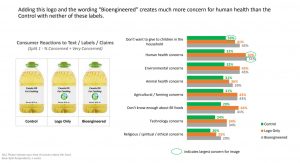
This graphic from the IFIC survey report shows how consumers concerns — for human health in particular — increase as a Bioengineered (BE) label or a BE label with explanatory text is added.

These two consumer surveys illustrate how complicated the public perception of GMOs is.  On one hand, as Kolodinsky puts it, “labels give consumers a sense of control, which has been shown to be related to risk perception.”  So, any labeling might reassure a shopper that they at least KNOW how their food was produced, which seems to increase their comfort level.

However this survey shows that there still appears to be a negative, gut-response to GMO foods from many consumers.  This could be linked to one or several different perceptions regarding the safety and impacts of GMOs across the food chain, and in feed/food and the mammals that consume it.

Given the continued flow of new GMO-crops and traits, this issue is surely not going away.  The smart money as soon as USDA published a final rule, the litigation will start.

As we discuss in our new section Future of Food, emerging, gene-silencing technologies like CRISPR will likely get a free pass from USDA and avoid labeling requirements, leaving consumers once again uncertain and concerned.

Sources:

Steve Davies,  “Simple labels increase consumer acceptance of GMOs, study finds”,  Agri-Pulse, June 27, 2018.

International Food Information Council, “IFIC Foundation Survey: Research with Consumers To Test Perceptions and Reactions To Various Stimuli and Visuals Related to Bioengineered Foods,” June 2018.

Jane Kolodinsky and Jayson Lusk, “Mandatory labels can improve attitudes toward genetically engineered food,” Science Advances, 2018, 4:6, DOI: 10.1126/sciadv.aaq1413

Posted in GMOs, In The News | Tagged Labeling, Policy and Politics

Related Posts

FAQs re Biden-Harris Ag and EPA Transition Priorities→

Implications of EPA’s Decision to Renew Dicamba Registration for Over-the-Top Use→

Dr. Benbrook Testifies Before the Philadelphia City Council as they Consider Glyphosate Ban→

Guest Blog: The Big Meat Gang Is Getting Awfully Smelly→

Why Promoting Organic Integrity Must Become a Top Priority for USDA→

Guest Blog: Finding the Root Cause of Organic Fraud→

So What About the Integrity of the U.S. Organic Grain Supply?→

Guest Blog: Organic Food & Pesticide Residues, One Grower’s Perspective→

©2016 Hygeia-Analytics.com. All Rights Reserved.

Menu