
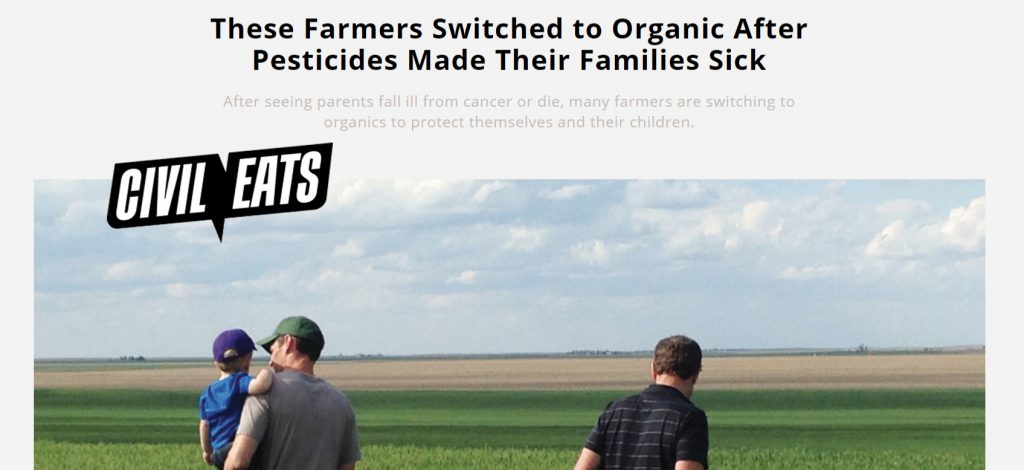
Ken Roseboro’s May 11, 2018 story in Civil Eats is a sober reminder that pesticides are toxic, some people have been exposed to levels that almost certainly trigger or contribute to disease, and that the most worrisome exposure episodes often occur as a result of unusual circumstances.
“These Farmers Switched to Organic After Pesticides Made Their Families Sick” recounts how pesticides likely impacted the health of several farmers and farm families. Many have suffered through clear-cut symptoms following pesticide exposures, and several paid a huge price as a result of serious, and sometimes life-threatening disease.
All those interviewed by Roseboro now believe that their transition to organic farming has reduced the risks they and their family members face, as well as their neighbors and America as a whole.
The nation invests a lot of money, scientist brain power, and lab animals in the pursuit of pesticide safety. It is increasingly clear that the way pesticides are tested, and the science of risk assessment supporting EPA’s regulatory decisions, misses the mark far too often.
This happens because EPA persists in ignoring four factors that obviously matter greatly when assessing pesticide risk:

1. How widely a pesticide is used in a region, and across the nation;
2. The mixture of pesticides that virtually 100% of the people on Earth, including nearly all Americans, are exposed to every day.
3. The fact that the pesticide products sold to farmers and the public contain several chemicals in addition to the “active” ingredient responsible for the product’s hoped for pest management benefit (see this link for much more on the health impacts of these adjuvants), yet EPA risk assessments are based almost exclusively on the toxicity and properties of the active ingredient alone.
4. The majority of birth defects, developmental problems, cancers, and other health problems triggered wholly or in part by pesticide exposures occur as a result of combinations of circumstances that are not considered by the EPA, or other regulators around the world.
For much more on the slew of health problems linked to pesticide exposure, see our extensive bibliography– over 350 items and counting- at the Managing Weeds for Healthy Kids page.
Let me add three personal stories — each a good example of unusual circumstances — to those in Ken’s story.
During junior high, a bunch of us often got together to play flag football after school in a nearby public park. Back in that era, 2,4-D was the “go to” herbicide for dandelion and other broadleaf weed control on playing ground and park fields. It still is in many places.
And the absolute best time to play was right after a hard rain, when the ground was saturated and soon, mud puddles would form. The result — a hybrid between slip and slide and rugby, masquerading as football. Every mother’s nightmare.
I remember several times walking home with a growing, sharp itch, bordering on pain, in my back and on my arms. A few times I had a rash. Often, my asthma flared up in the evening. It does not take a rocket scientist to figure out why — some of the 2,4-D sprayed a few days before had moved with rain into the puddles.
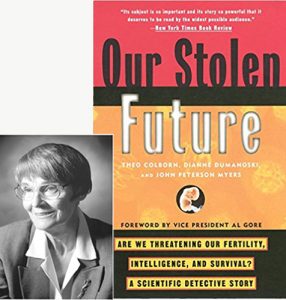
My dear late friend Theo Colborn raised awareness about endocrine disrupting chemicals, including pesticides, through her scientific work and many seminal publications, which include Our Stolen Future and the Wingspread Statement (to access the statement and understand its huge impact, see this well-deserved tribute to Theo in Environmental Health Perspectives).
Her path back to graduate school, leading to a life dedicated to science, started on an interstate highway in Nebraska, one early summer afternoon, when a spray plane zoomed across the highway that Theo was driving along, with her windows open. An OP insecticide flowed into and through her car, resulting in a mammoth, dangerous exposure episode. Theo lived through it, but paid a huge price as a series of health problems likely caused or made worse by this exposure episode grew worse, and eventually killed her.
In the early part of my near 20 years working in the D.C. area and living in the country outside the capital, I was part of a car pool. Another member, a friend and neighbor, worked on ag issues for a federal agency. He also ran a pick-your-own strawberry and pumpkin operation that was very successful. He and his wife had developed a thriving business hosting school bus loads of kids who got to pick their families pumpkin, or enjoy freshly picked strawberries.
A couple times each year, with a big weekend ahead as a result of special events and advertising, and a nice strawberry crop coming on, he would have to deal with a rapidly spreading fungal disease (usually when it was wetter than normal), or some hungry bug (often when it was hotter than normal). He did so by spraying the “go to” fungicide or insecticide of the day, usually an organophosphate.
Many times, during the morning commute the day after he had to do such an emergency spray application, he recounted how he had to fight off the symptoms caused by his exposure, as he drove his tractor (with no cab) around the field and finished the application.
When done, he would drive the tractor right to the house, step off and walk directly to the shower, and try to rinse off the chemical that he knew was making him sick. Several times he almost passed out.
Compare my neighbor’s experience with those told by some of the farmers in Roseboro’s piece.
And then ponder the exposures that occurred a few days later, when dozens of families, many with young children, visited the farm, and with great expectations, picked the ripe, juicy berries right off the plants, which, by the handful, then went in their mouths.
Source:
Ken Roseboro, “These Farmers Switched to Organic After Pesticides Made Their Families Sick,” Civil Eats, May 11, 2018