
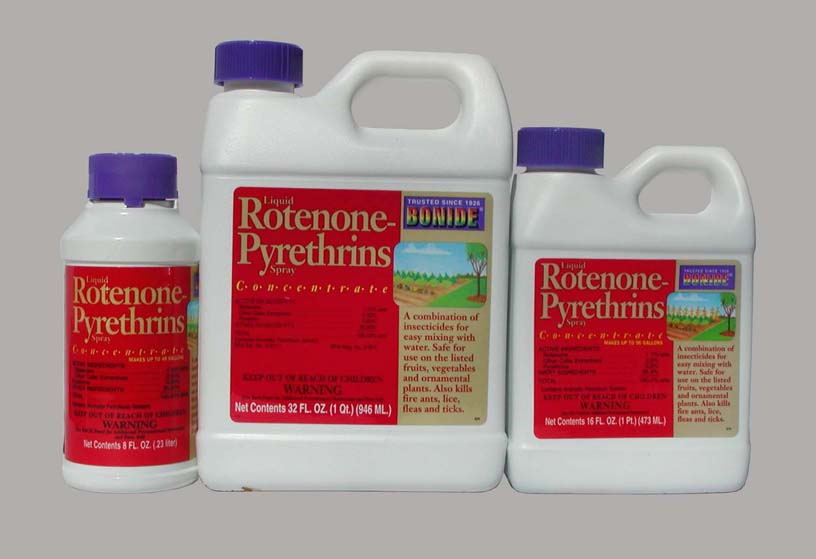
By Brian Baker
Rotenone is a non-synthetic botanical insecticide and piscicide (chemical poisonous to fish) derived from the roots of Derris spp., Lonchocarpus spp. and Tephrosia spp. It has been used historically in organic production, usually with restrictions that limit its impact on human health and the environment. Prior to the isolation and commercialization of organically acceptable formulations of spinosad, rotenone was used as a broad-spectrum insecticide for the control of a wide variety of pests in numerous crops. However, uses of rotenone appeared to be waning both on organic and conventional farms, even before registrations were cancelled (Isman, 2006).
Because of its toxicity to fish, rotenone has long been recognized as having adverse impacts on aquatic ecosystems. More recently, studies have brought forth concerns regarding the human health impacts of rotenone. Rotenone’s acute toxicity is higher than most other biopesticides and botanicals currently used in organic farming. Its mode of action was known to be neurotoxic, but the specific mechanism of inhibiting the mitochondrial electron transport chain was first understood about 20 years ago (Hollingworth et al., 1994). More recently, rotenone exposure has been linked to Parkinson’s disease (Sherer, et al., 2003; Tanner, et al., 2011).
Current US Regulatory Status
The most recent Re-registration Eligibility Decision (RED) document was issued by EPA in March, 2007. The RED identified numerous data gaps that needed to be filled in order for food uses of rotenone to be re-registered. Rather than gather the data and conduct the analyses necessary to support the establishment of maximum contaminant levels, the registrants chose to submit voluntary cancellation notices. The EPA began the process of cancelling all registered food uses of rotenone in the U.S. shortly after the 2007 RED. The final notification was published July 28, 2010 [75 FR 44256]. The product cancellation order became effective on March 23, 2011 [76 FR 16415]. Registrants were permitted to sell their existing inventories until May 23, 2011.
EPA continues to exempt rotenone from the requirement of a tolerance. The exemption language was modified to reflect the cancellation of all U.S. food use registrations [77 FR 59128, Sept. 26, 2012]:
When applied to growing crops, in accordance with good agricultural practice, the pesticides rotenone or derris or cube roots are exempt from the requirement of a tolerance. There are no U.S. registrations for use of rotenone, derris, or cube roots on food commodities as of March 23, 2011 [40 CFR 180.905(b)].
On September 26, 2012, EPA announced that it would not remove the “tolerance exemptions for rotenone, derris or cube roots at this time” [77 Fed Reg 59120]. Because it is exempt from tolerance, food is rarely tested for rotenone residues and there is no amount in food that would violate federal law or regulations. Rotenone continues to be used legally in many countries outside the US, so risk of exposure would presumably come mostly from imports.
Status under the USDA National Organic Program
The USDA’s National Organic Standards Board (NOSB) was required by the Organic Foods Production Act (OFPA) to conduct a special review of botanical pesticides before the establishment of the National List [7 USC 6518(k)(4)]. Following that special review, the NOSB voted against adding the substance to the prohibited non-synthetic list (NOSB, 1994). Because rotenone is not on the National List of prohibited non-synthetic substances [7 CFR 205.602] it can continue to be used for organic production where it is legally registered for food crop uses. Current use in global organic production is difficult to estimate. In 2012, the NOSB recommended that rotenone be prohibited effective January 1, 2016 (NOSB). The NOP has not yet acted on the NOSB’s recommendation.
After implementation of the National Organic Program (NOP) in 2002, no rotenone formulations registered by EPA were ever deemed in compliance with the NOP. No products that contained rotenone as an active ingredient were ever listed as allowed for use on organic farms by the Organic Materials Review Institute (OMRI). Some formulations contained synthetic synergists as active ingredients, such as piperonyl butoxide (PBO). Other formulations contained inert ingredients that were not on EPA List 4 (Minimum Risk). While enforcement of the inert ingredients provision of the NOP rule varied by accredited certification agent (ACA) and phase-in of that provision was delayed by NOP guidance, most certified organic farmers in the US stopped using rotenone by the time that the NOP rule was implemented on October 22, 2002. A few products remained registered mainly for home and garden use, for ornamentals and for use as a piscicide.
International Status
The European Union (EU) began a phase-out of rotenone in 2008 [EC 2008/317]. The final authorization was withdrawn October 31, 2011. The pesticide database of the Director General of Health and Consumers for the EU showed that rotenone was not approved for use in the EU and was not authorized for use in any EU member state (DG Sanco, 2014). Switzerland began the process to ban rotenone in 2011 (BLW, 2011). Swiss authorities announced on October 23, 2013, rotenone was deleted from the list of approved pesticides, with an effective date of January 1, 2014 (BLW, 2013).
The Canadian Pest Management Regulatory Agency (PMRA) announced in 2008 that all non-piscicidal sales of rotenone would be discontinued effective December 31, 2008. All domestic and commercial uses of rotenone, other than for the control of fish, were phased out December 31, 2012.
In 2009, the Codex Alimentarius Commission considered a proposal to delete it from the list of approved substances for plant protection (Annex 2). The proposed deletion was supported by Argentina, Japan, and Kenya. The deletion was opposed by Australia, Brazil, Iran, Mexico, the Phillipines, Thailand and the United States, as well as the International Federation of Organic Agriculture Movements (IFOAM) (CAC, 2009). Most of the member states and non-governmental organizations that opposed the ban of rotenone recognized the risks and theneed for further restrictions.
Access the pdf version of this text.
References
BLW (Bundesamt für Landwirtschaft). 2011. Pflanzenschutzmittelbewilligungen Aktualisierung. Accessed February 24, 2014.
BLW (Bundesamt für Landwirtschaft). 2013. Bundesrat setzt Agrarpolitik 2014-2017 um. October 23, 2013. Accessed February 24, 2014.
CAC (Codex Alimentarius Commission). 2009. Guidelines for the production, processing, labelling and marketing of organically produced foods: Annex 2: deletion of rotenone (CL2008/27-fl): Government comments at step 3. Accessed February 24, 2014.
DG SanCo (European Union Director General for Health and Consumers). 2014. Accessed February 24, 2014.
EC (European Commission). 2008. Concerning the non-inclusion of rotenone, extract from equisetum and chinin-hydrochlorid in Annex I to Council Directive 91/414/EEC and the withdrawal of authorisations for plant protection products containing these substances. EC 2008/317, published April 10, 2008.
PMRA (Pest Management Regulatory Agency, Health Canada). 2008. Rotenone Re-evaluation Note. Ottawa, ON: Health Canada.
Hollingworth, RM, Ahammadsahib, KI, Gadelhak, G and McLaughlin, JL. 1994. New inhibitors of complex I of the mitochondrial electron transport chain with activity as pesticides. Biochemical Society Transactions 22: 230-233.
Isman, MB. 2006. Botanical insecticides, deterrents, and repellents in modern agriculture and an increasingly regulated world. Annual Review of Entomology 51: 45-66. Doi: 10.1146/annurev.ento.51.110104.151146.
NOSB (National Organic Standards Board). 1994. Botanical Pesticides Policy. Accessed February 5, 2014.
NOSB (National Organic Standards Board). 2012a. Petition to add Rotenone to the National List §205.602 as a Prohibited natural. Accessed February 5, 2014.
NOSB (National Organic Standards Board). 2012b. Proposal to add Rotenone to the National List §205.602 as a Prohibited natural. Accessed February 5, 2014.
Sherer, TB, Betarbet, R, Testa, CM, Seo, BB, Richardson, JR, Kim, JH, Miller, GW, Yagi, T, Matsuno-Yagi, A, and Greenamyre, JT. 2003. Mechanism of toxicity in rotenone models of Parkinson’s disease. Journal of Neuroscience 23: 10756—10764.
Tanner CM, Kamel F, Ross GW, Hoppin JA, Goldman SM, et al. 2011. Rotenone, Paraquat, and Parkinson’s Disease. Environmental Health Perspectives 119(6). doi:10.1289/ehp.1002839.
US EPA. 2007. Re-registration Eligibility Decision for Rotenone. US EPA Case #0255.