
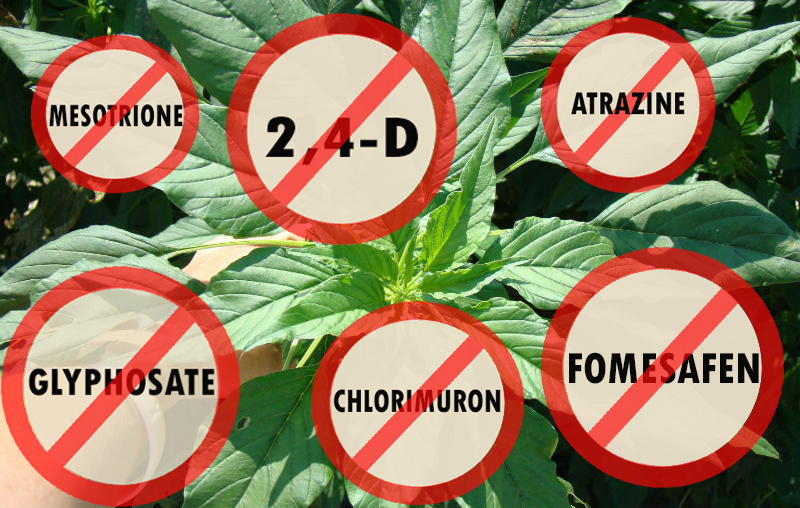
In an experiment conducted in Missouri, researchers have identified Palmer amaranth that is resistant to six herbicides.
Amaranthus palmerii is a one tough weed. When full grown, at its base, stalks can match the circumference of a man’s wrist. One plant can set over 400,000 seeds. It has a long history of herbicide resistance, and for many farmers, Palmer Amaranth is near the top of the list of most-feared and costly weeds.
Previous research has identified populations resistant to multiple herbicides, such as this Argentinian population resistant to glyphosate, dicamba and 2,4-D. This is the first time, however, that resistance has been reported to six different herbicide modes of action.
A research team from the University of Missouri published a paper in Weed Science with this bad news. The team also report some interesting discoveries about how resistance develops.
Resistance Spreads Quickly
The percentage of “visual control” observed in weed populations year by year has changed significantly. For example, for 2,4-D application rates ranging from 0.56-4.48 kilograms per hectare (kg/ha), visual control of Palmer amaranth ranged from 26-77% in 2015. But, visual control decreased to 15-55% in the following year.
Resistant Weeds Can Still Be Killed (Sometimes)

But it takes a lot more herbicide and multiple modes of action, if herbicides work at all. The researchers compared the resistant plants to control populations that were still sensitive to these herbicides, and measured how much herbicide was needed to kill weeds in each population.
In one such example, to achieve 50% control of waterhemp, application rates of 2,4-D increased from 0.47 kg/ha in the control population to 1.44 kg/ha for the resistant population. That’s over triple the amount of herbicide.
These rates skyrocketed for other herbicides tested. Resistant waterhemp needed 7 times as much atrazine, 14 times as much mesotrione, and 22-times more glyphosate.
Multiple Resistance is Depressingly Common
For Palmer amaranth in Missouri, resistance to just one herbicide is a rarity. In fact, only 1% of the populations studied was resistant to just one herbicide (glyphosate). Plus, about 1 in 6 (16%) of the weed plants were resistant to six of the herbicides studied: 2,4-D, atrazine, chlorimuron, fomesafen, glyphosate, and mesotrione.
Few Tools Left in the Toolbox
For the 16% of the populations of amaranth resistant to six herbicides, only dicamba and glufosinate proved effective in controlling the weeds, as this article from Soybean South describes. But, earlier reports of dicamba-resistant weed populations in some states raise concerns that dicamba-resistance might spread quickly.
Given that dicamba use in the U.S. is rising fast, the rapid-spread scenario seems likely. Despite promises by Monsanto (now Bayer) that these new formulations would not be volatile, herbicide drift and movement has remained a big problem. As a result, weeds far and wide are being exposed to low-levels of dicamba, even those growing in fields that are not planted to dicamba-resistant crops. And such low-level, not-lethal exposures are prone to triggering resistance, and hence over time, will further accelerate the herbicide treadmill.
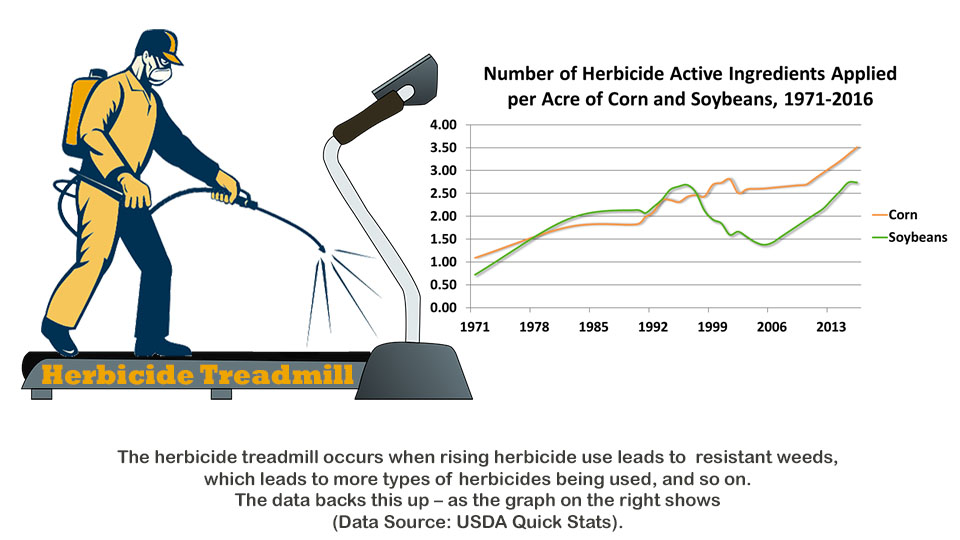
2,4-D resistant corn, soybeans, and cotton are the next-gen resistant crops about to hit the market. But this study documents that 2,4-D resistance is already a problem in multiple weeds. It remains puzzling why so many conventional farmers remain supportive of such a deeply flawed weed management strategy, since they are the ones paying more and more year-to-year for herbicide-based management systems that work less and less well.
“The results are sobering – especially for anyone waiting on the approval of 2,4-D–resistant corn and soybeans as a way to manage glyphosate resistance. If we’re already seeing 2,4-D resistance now, what will happen when use of the herbicide becomes even more commonplace?”
The solution?
According to Soybean South, the researchers feel that “six-way resistant waterhemp demands a diversified approach.” This is the “many little hammers” strategy that relies on a variety of mechanical, biological, and chemical control methods, rather than the near-sole reliance on herbicides that is the norm today.
There is plenty of good science showing that diversified weed management can work, the problem is figuring out how to support farmers willing to switch gears after many years of incrementally more heavy-handed herbicide use. The switch is challenging and will take time and money, because so many farmers have invested for years almost exclusively in the large-scale equipment, seed genetics, and know how needed to spray lots of herbicides across very large farms, quickly, with very few people. The other compartments in the weed management “toolbox” are empty, or rusty and outmoded.
Excessive reliance on herbicides has led to a “wicked problem.” The way forward is clear and proven, and entails less use of herbicides, coupled with integration of multiple, non-chemical weed management practices and tactics.
Economics will eventually dictate that “many little hammers” replace the one big one causing such costly problems on many of the nation’s largest and most “progressive” farms.
Sources:
Shergill, L., Barlow, B., Bish, M., & Bradley, K., “Investigations of 2,4-D and Multiple Herbicide Resistance in a Missouri Waterhemp (Amaranthus tuberculatus) Population,” Weed Science, 66(3), 86-394, 2018, doi:10.1017/wsc.2017.82
Soybean South, “Missouri Scientists Find Waterhemp Resistant to 6 Herbicide Modes of Action,” October 11, 2018.