
Hygeia AnalyticsLogo

Menu

Skip to content
  • Home
  • About Hygeia
    Analytics
    • Dynamic Presentations
    • Keywords and Site Map
    • Hygeia Analytics – Who We Are
    • Why Hygeia?
    • Funding and “Sound Science”
    • Acronyms and Glossary
    • Sign-Up for Updates
  • Nutrition
    • Introduction and Nutrition 101
      • Good Fat Bad Fat
      • Fatty Acids
        • Primer on the Fatty Acids in Milk
      • Impact of Livestock Feeding
    • Antioxidants
      • Organic Farming Elevates Antioxidants
      • Maximizing Antioxidant Intake
    • Organic vs. Conventional Foods
      • Milk and Dairy Products
        • 2018 Grassmilk Paper
        • PLOS ONE Study
        • Dairy Meta-Analysis
      • Multi Food Meta-Analyses
        • Meat Products
        • Plant-Based Foods
        • Smith-Spangler et al.
        • Dangour et al.
        • The Organic Center Report
      • Food Specific Comparisons
        • General
        • Fruits and Vegetables
        • Wine and Wine Grapes
    • Considering Nutritional Quality
      • Impact of Genetics and Production Systems
      • New Tool for Food Security
      • Transforming Jane Doe’s Diet
      • Nutritional Quality Index
    • Nutrient Decline
    • Other Choices and Challenges
      • Human Health
      • Dietary Choices
  • Pesticides
    • Usage
      • Pesticide Use Data Sources
        • Pesticide Use Indicators
      • PUDS – The Pesticide Use Data System
    • Dietary Risks
      • The Dietary Risk Index (DRI)
    • Risk Assessment and Regulation
      • Food Quality Protection Act (FQPA)
      • Glyphosate/Roundup Case Study
      • The Lowdown on Roundup
      • Does Glyphosate/Roundup Cause Cancer?
      • 2019 Glyphosate Genotoxicity Paper
    • Impacts of GE on Pesticide Use
    • Environmental, Human Health, and Other Impacts of Pesticides
  • Ag Biotech
    • Key Historical Documents – Donald Duvick
    • Key Historical Documents – Arpad Pusztai
    • Herbicide Resistant Crops
    • Weed Resistance
    • Bt Transgenic Crops
    • Resistant Insects
    • Health Risks and Safety Assessments
    • Regulation of GE Crop Technology
    • Marketing, Economics, and Public Relations
    • Patenting and Intellectual Property Issues
    • Labeling
  • Other Issues
    • Animal Products
    • The Future of Food
    • Global Food Security
    • Natural Resources and Climate Change
    • Alternatives to Industrial Ag
    • Policy and Politics
    • Scientific Integrity
    • Soil Health
    • Yields
  • Recent Posts
    • Hot Science
    • In The News
    • Hygeia’s Blog
  • Special
    Coverage
    • Organic Apples in Washington State
    • Dicamba Drift Crisis
    • Organic Food Consumption Lowers Cancer Risk
    • Organic Integrity

Syngenta is Playing with Fire in Its Efforts to Break Up the Bayer-Monsanto Marriage

Posted on February 20, 2018 in Hygeia's Blog, Pesticides | 311 Views

A new opinion piece recounts how a Syngenta-linked PR firm has apparently started a non-profit front-group to challenge Bayer’s acquisition of Monsanto.  Opposition to the union of these two industry leaders rests in the fear of anti-competitive activity, leading to adverse impacts on farmers in the wake of higher seed prices and limited choices in the genetic traits brought to market.

The non-profit advocacy group in question, Farmers and Families First, released a glossy report in December 2017 called  “A Monsanto-Bayer Merger Will Raise the Price of Agricultural Inputs, Reduce Seed Choices and Increase Costs for U.S. Farmers.”
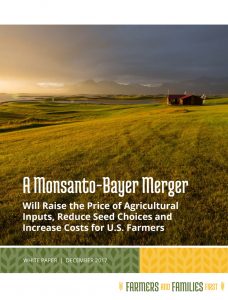
This glossy report by a new non-profit opposing the Bayer-Monsanto merger raises suspicions of involvement of competitors like ChemChina, now owners of Syngenta.

Highly polished and professional, the report is brimming with hard to obtain details on inside-the-industry market dynamics and drivers.

It is an impressive piece of work, especially given that it was supposedly produced by a non-profit that has only been in operation for a few months.  In fact, Farmers and Families First held the first meeting of their advisory board in January 2018.

It is certain that the report was written by people with deep knowledge of the industry, in fact so deep it had to have come from industry insiders, e.g. Syngenta, which was recently acquired by state-owned ChemChina

And as recently reported, Syngenta is a long-term client of the PR firm that developed the report, DDC Public Affairs.

The report is a good example of what an NGO can do with a substantial publication budget. In an interesting twist, the Farmers and Families First report draws substantial data from a 2011 report I wrote for the The Organic Center (TOC).

This 2011 TOC report compared the seed price premium paid by organic corn and soybean farmers, in contrast to the seed price premium paid by conventional farmers planting GE-seeds instead of non-GE seed. Its key, and unexpected, finding is that the GE-seed price premium is much larger than the organic seed price premium.

The analytical work done in the course of writing the TOC report included developing a seed price-farm income database structured to quantify the impact of the price of biotech corn, soybeans, and cotton seed on cash farm expenditures and net per acre farm income.  The Farmers and Families First report cites (see footnotes 16-21) a TOC two-page summary of the full TOC report.

Our database on trends in seed prices and farm income has been updated and expanded since the work leading to the 2011 report. The impact of today’s GE seed prices, and the heavy pesticide use they require through a growing season, has cut deeply into net farm income.

In short, an incrementally greater share of every dollar earned by conventional corn and soybean farmers planting GE seeds goes to the companies producing the GE seeds. While the impact was significant in 2011, it will be tsunami-scale in crop year 2018.

And so, ChemChina-Syngenta may have opened a can of worms with its contributions to the Farmers and Families First report. As farmers realize the high price they are paying for the opportunity to use “modern (GE) technology,” some will undoubtedly begin questioning who has really benefited from first-generation, GE crop technology.

Sources:

Charles Benbrook, “The Magnitude and Impacts of the Biotech and Organic Seed Price Premium,” The Organic Center Critical Issue Report, December 2009.

Farmers and Families First,  “A Monsanto-Bayer Merger Will Raise the Price of Agricultural Inputs, Reduce Seed Choices and Increase Costs for U.S. Farmers.” White Paper, December 2017.

Kevin Mooney, “Is China behind this campaign against the Mosanto merger?,” Washington Examiner, February 19, 2018.

The Organic Center, “The Unsettling Story of Seeds,” Highlights of a Critical Issues Report, March 2011.

Posted in Hygeia's Blog, Pesticides | Tagged Economics, Policy and Politics, Seeds

Related Posts

FAQs re Biden-Harris Ag and EPA Transition Priorities→

Implications of EPA’s Decision to Renew Dicamba Registration for Over-the-Top Use→

Neonic Seed Treatments in the (Science) News→

Dr. Benbrook Testifies Before the Philadelphia City Council as they Consider Glyphosate Ban→

Guest Blog: The Big Meat Gang Is Getting Awfully Smelly→

Why Promoting Organic Integrity Must Become a Top Priority for USDA→

Guest Blog: Finding the Root Cause of Organic Fraud→

So What About the Integrity of the U.S. Organic Grain Supply?→

©2016 Hygeia-Analytics.com. All Rights Reserved.

Menu