
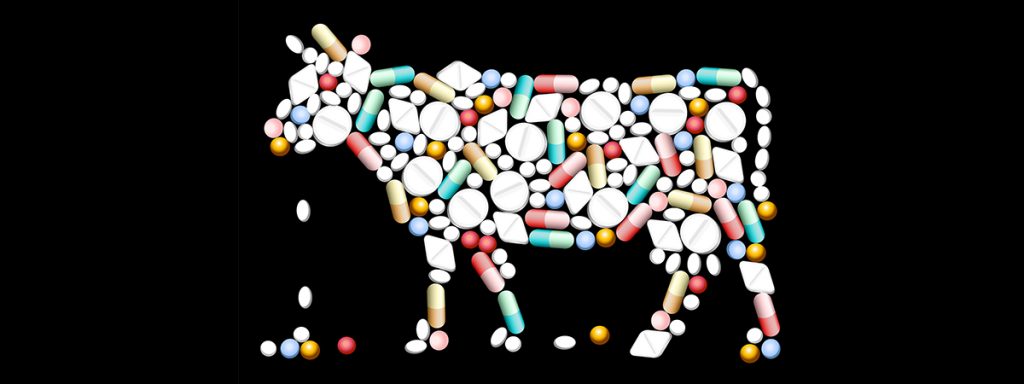
Despite the mountains of evidence showing that we are loosing the race to preserve the efficacy of medically important antibiotics, sales of these vital drugs to livestock farmers have risen 26% since 2009, according to the latest FDA report on the subject, “Antimicrobials Sold or Distributed for Use in Food Producing Animals”.
I first studied this issue in the late 1990s, working with colleagues at the Union of Concerned Scientists. We produced a widely read and impactful 2001 report called “Hoggin’ It: Estimates of Antimicrobial Abuse in Livestock.”
We modeled both human and agricultural antibiotic/antimicrobial use and concluded that –
- Antibiotic use on livestock farms was enormous – almost 25 million pounds – and had increased 50% from 1985 to 2000.
- About one-half of the antibiotics used on U.S. farmers were prohibited for comparable farm uses in the European Union.
- About 8 pounds of antibiotics were given to mostly healthy farm animals for every 1 pound used to treat infections in humans.
These remarkable findings were heavily covered in the media. Hoggin’ It has been specifically cited in at least three editorials in the New York Times over the years. The FDA acted upon several of the report’s recommendations, yet relatively little has changed in overall livestock antibiotic use, and the most recent FDA data shows a substantial, 26% increase from 2009-2015.
Fortunately, many livestock farmers and some food companies have recognized the severity of this problem. Various companies have taken actions ranging from modest to decisive in an effort to reduce livestock agriculture’s contribution to the emergence and spread of resistant bacteria that move from farms, to people in rural areas working on or near livestock farms, and then on through the human population.
Organic livestock farmers and food companies do not use any antibiotics, and so no longer contribute to the problem. But without much more broad-based changes on conventional chicken, hog, and beef farms, our concentrated livestock feeding operations will remain the major well of newly resistant bacteria. And once “created,” resistant bacteria and their genes will continue to find their way into the human population.
Antibiotic resistant genes with their roots on the farm will move from one bacterium to others, and the efficacy of antibiotics will continue to slip in treating and preventing all sorts of common human infections.
The consequences are already serious, and will worsen in the absence of much more focused, systematic effort to stop the emergence of newly resistant bacteria from livestock farms.
In the current political climate, it is hard to imagine the government even sustaining current, grossly inadequate efforts to turn the tide. Which brings us to the possible Trump effect.

Many people are predicting a substantial increase in consumer activism targeting farmers and food companies, as it becomes apparent that the government cannot be trusted to take the sort of decisive, yet highly controversial actions needed to have a meaningful impact on agricultural antibiotic use, and more broadly, the prevalence and spread of antibiotic resistant bacteria.
The Trump effect could quickly build into a powerful force driving positive change, especially if growing segments of the scientific and biomedical communities decide to speak up more forcefully about the consequences of further erosion in antibiotic efficacy.
Most farmers could, but likely won’t change how livestock are raised in the U.S. in ways that promote animal health and greatly reduce the need for routine antibiotic use. Regrettably, it will likely take a catastrophic loss of antibiotic efficacy before the political clout of the livestock industry will be overwhelmed by the collective fury of people told by their doctors that even routine surgery, or a chest cold or ear infection, have become possibly life-threatening medical emergencies.
At least for the next few years, our best hope is that worried consumers will vote with their food dollars and support companies that work with farmers willing to end non-therapeutic antibiotic use. Indeed, several major players in the U.S. food industry have taken positive steps in the right direction.
Data from Europe shows clearly that preventive measures work. The frequency and severity of resistant bacteria on livestock farms in several EU countries is dropping, and some previously ineffective antibiotic uses are regaining their ability to control once-resistant bacteria, a very hopeful sign.
Source:
U.S. Food and Drug Administration, “FY 2016 Performance Report to Congress for the Animal Drug User Fee Act”