
Guest Blog by Alan Guebert from farmandfoodfile.com
Reprinted by permission of the author.
In a year of too many dark days, Monday, Sept. 14 was a particularly dark day for every American for two reasons.
First, on Sept. 14, ProPublica, the non-profit, investigatory news group, published a 3,100-word exposé on how global meatpackers used their clout this spring to get a White House order to keep workers on the job despite the fast-spreading coronavirus sickening and, in a rising number of cases, killing the workers.
The second reason is the death of Tony Corbo, the senior lobbyist for food safety and clean water at Food & Water Watch. If you didn’t know him, just know he spent decades fighting for your right to safe food. More on him later. (Hint: the Big Meat Gang knew Corbo—well.)
First the ProPublica story.
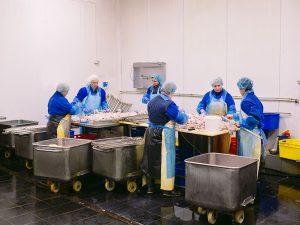
The coronavirus found a perfect place to root and grow this spring, in the tight quarters of America’s massive livestock and poultry slaughterhouses. Local public health officials responded to virus outbreaks by ordering workers tested and, in some instances, plants closed.
To counter these local shutdowns, major packers and their lobbying arm, the North American Meat Institute (NAMI), drew the Trump Administration a roadmap on how the government could keep slaughterhouse workers on the job despite the pandemic.
“Just a week before” the White House issued its rare, April 28 order to force workers back into plants, explains ProPublica, NAMI “drafted an executive order that bears striking similarities to the one the president signed.”
In fact, “The draft executive order was one of hundreds of emails between the companies, industry groups, and top officials at USDA since March,” it continues.
Heavy-handed lobbying by Big Agbiz is not unusual. What is unusual, however, is the “quick seven-day turnaround, even amid an emergency like COVID-19” to get White House action.
USDA wasn’t the only federal agency to spring into action. Shortly after Big Meat made its pitch to the White House, “… the Labor Department, which had been hearing similar complaints… issued guidance clarifying that workers who quit to avoid contracting the disease wouldn’t receive jobless benefits.”
As coldhearted as that was, the packer lobbyist asked for even more. “Hearing a strong and consistent message from the President or Vice President,” wrote Julie Anna Potts, NAMI’s president, in an email, “… is vital: being afraid of COVID-19 is not a reason to quit your job and you are not eligible for unemployment compensation if you do.”
Shortly thereafter, U.S. Secretary of Agriculture Sonny Perdue was empowered to order the worried and, in some instances, already Covid-infected, employees back to work. Then, to ensure they went, the government removed any safety net if they quit out of fear or illness.
With little recourse, most of the browbeaten and scared—65 percent of U.S. meatpacking employees identify as either Black, Brown, and/or immigrant—went back to work. As a result, says ProPublica, more than 43,000 were sickened by Covid-19 and “at least 195” died.

Enter Tony Corbo, who spent most of his Capitol Hill career monitoring and improving federal food and water safety rules and regulations. If you reported on food safety and didn’t have Tony Corbo on speed dial, you weren’t doing your job.
As senior lobbyist at Food & Water Watch, Corbo sniffed out Big Meat’s back-to-work request of USDA in mid-April and raised a series of red flags. Then, in July, (when I last talked to him) Corbo again raised alarms on how Big Meat was using the pandemic to get USDA to further weaken already lax poultry slaughter rules.
Sadly, Tony Corbo died Monday, Sept. 14, the same day ProPublica published its shocking story about how powerful, vertically integrated meatpackers basically made a telephone call to the White House and USDA to force powerless workers back to jobs where thousands would be sickened and hundreds would die.
And it’s still going on even as most U.S. meat producers—and they are producers because the packers, not individual farmers, own the overwhelming majority of America’s slaughter animals today—are increasingly supported by taxpayer subsidies just to stay in business.
But even that’s not enough for the packers. Now they are literally writing their own food—and employee—safety rules.
Boy, are you—and I—going to miss Tony Corbo.
© 2020 ag comm