
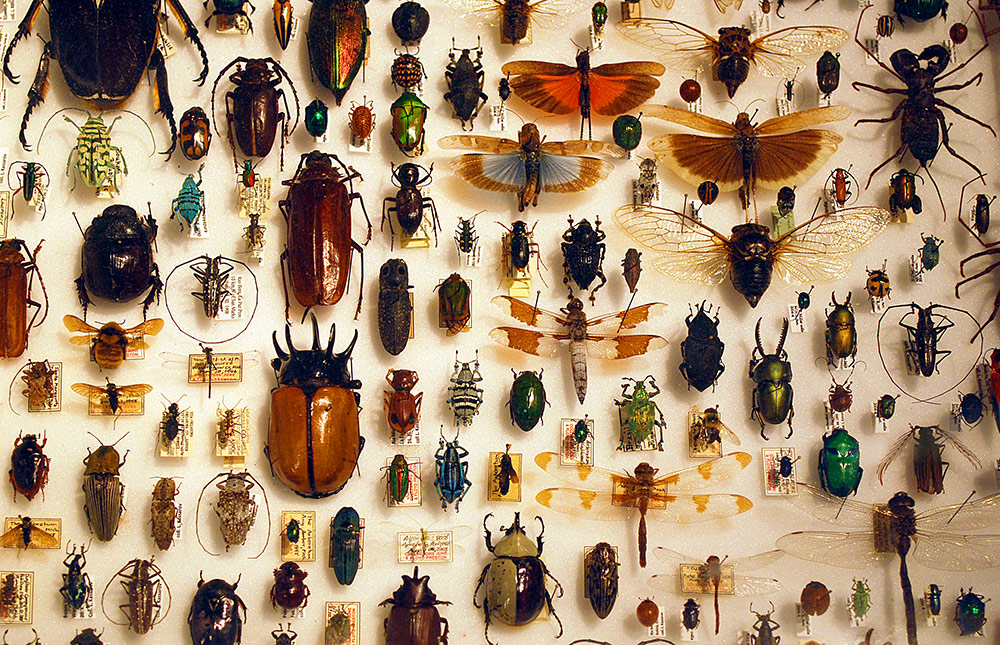
A duo of research scientists from Australian universities have conducted an extensive review of global data on insect populations, with stark results.
Their analysis of 73 historical reports was published this month in the journal Biological Conservation. It reveals “dramatic rates of decline that may lead to the extinction of 40% of the world’s insect species over the next few decades” (Sánchez-Bayo and Wyckhuys, 2019).
The main culprit behind these widespread declines is “agricultural intensification” due to, first, habitat loss from land use changes and second, the multiple, negative impacts of intensive, widespread, recurrent pesticide use (for an example of the kind of studies they sampled, see our piece from last year where we summarize results of two from Puerto Rico and Germany that were included in this review).
“Insects” the authors write, “are at the structural and functional base of many of the world’s ecosystems since their rise at the end of the Devonian period, almost 400 million years ago” (Sánchez-Bayo and Wyckhuys, 2019). Declines of the magnitude they report will have serious consequences to ecosystems around the globe.
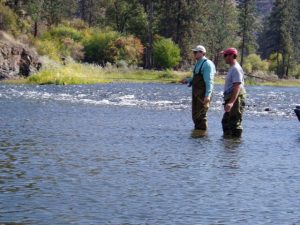
A closer look at the 73 insect population studies included in this meta-analysis revealed that Lepidoptera (butteflies and moths), Hymenoptera (bees and wasps) and parts of Coleoptera (the dung beetles) were the most affected terrestrial taxa, while Odonata (dragonflies and damselflies), Plecoptera (stoneflies), Trichoptera (caddisflies), and Ephemeroptera (mayflies) are the aquatic insect taxa most in decline. Fly fisherman will recognize these as some of the key freshwater-insect prey for trout, salmon and other sportsfish, and the fly-tying challenge “match the hatch.”
In a story on their website about this new meta-analysis, the BBC focuses on the fact that populations of many common insect species that are adaptable to living with humans are actually increasing. Many of these are what we call “pests”- think mosquitoes, cockroaches and some flies.
“It’s quite plausible that we might end up with plagues of small numbers of pest insects, but we will lose all the wonderful ones that we want, like bees and hoverflies and butterflies and dung beetles that do a great job of disposing of animal waste,” says Professor Dave Goulson from the University of Sussex (McGrath, 2019).
The new paper in Biological Conservation also determined that declines in insect populations are “substantially greater” than the trends observed in plants, birds, and other groups over a similar period. Although given the important role insects play as a food resource for many vertebrates, it is likely that similar declines in insectivorous species will be coming soon.
“We are,” the authors warn “witnessing the largest extinction event on Earth since the late Permian and Cretaceous periods” (Sánchez-Bayo and Wyckhuys, 2019).
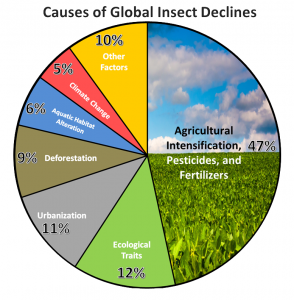
Drivers of population decline were also noted when reported for each of the 73 studies included in the analysis. Of all the causes contributing to insect declines, agriculture was by far the most significant.
The conversion and intensification of land use for agriculture is listed in 24% of the studies analyzed, while pesticide and fertilizer use are implicated in 13% and 10% respectively. So, overall, agriculture was a factor in almost half – or 47% – of reported population declines.
While land use changes from agriculture, including the channelization and draining of waterbodies and wetlands, has had a serious impact on insect populations, the authors point out that pesticide use is also implicated in many studies.
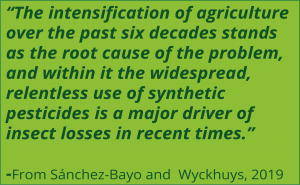
While insecticides are obviously the most toxic pesticide group for insects, the authors argue that “the application of herbicides to cropland has had more negative impacts on both terrestrial and aquatic plants and insect biodiversity than any other agronomic practice” (Sánchez-Bayo and Wyckhuys, 2019). This is because herbicides reduce overall biodiversity of vegetation due to damage from drift and runoff, and their impact is felt across the landscape.
The authors call for “a drastic reduction in agro-chemical inputs and agricultural ‘redesign’” (Sánchez-Bayo and Wyckhuys, 2019). Their voices are now added to the many echoing a call for a serious change in the way food crops are grown and farm animals raised in the U.S. and around the world.
In an article by The Guardian about this review, prominent insect scientists and policy makers highlight that people who want to do something to support insect population recovery should choose to buy organic at the grocery store. “If you buy organic food, you make sure the land is used less intensively,” says Professor Axel Hochkirch, the lead on insects for the International Union for the Conservation of Nature, who is quoted in the story. “There are a lot of studies that show organic farming is better for insects than intensive farming” (Carrington, 2019).
As it stands now, between the monster, herbicide-resistant weeds, declining nutritional quality of food, the high greenhouse gas emissions, and the human health and ecological cost caused by our modern food system, it seems inevitable that the chorus of voices for change will quickly becoming a cacophony. Time will tell if anyone is listening.
Source:
Damian Carrington, “Buy organic food to help curb global insect collapse, say scientists,” The Guardian, February 13, 2019.
Matt McGrath, “Global insect decline may see ‘plague of pests,'” BBC, Published online: 02/11/2019, Date accessed: 02/13/2019.
Sánchez-Bayo, Francisco and Wyckhuys Kris A.G., “Worldwide decline of the entomofauna: A review of its drivers,” Biological Conservation, 2019, 232:8-27. DOI: 10.1016/j.biocon.2019.01.020.