

In an in-depth piece that ran in The Oregonian and online at Oregon Live, writer Julia Rosen with High Country News tells the sorry tale of how glyphosate resistant creeping bentgrass meant for high-dollar golf courses has become a thorn in the side of high-desert farmers and ranchers along the Oregon-Washington-Idaho border.
Starting in the 1990s, two agribusiness giants – Scotts Miracle-Gro and Monsanto – teamed together to develop herbicide-resistant (HR) bentgrass. This grass is the preferred turf for the world’s most premier golf courses, who were willing to pay top-dollar for glyphosate resistant seed. Once approved, this would be the first commercially available HR grass.
The story of how HR bentgrass was lackadaisically regulated by USDA/APHIS is a familiar one. Field trials conducted by the companies themselves “proved” the plant was safe, and they quickly petitioned APHIS for deregulation in 2003.
While waiting for regulatory approval, Scott was allowed by USDA to plant a few hundred acres of their HR bentgrass in a couple of fields in Idaho and Oregon. They choose isolated, irrigated land in the high desert away from the Willamette Valley’s lush vineyards and high-value cropland.
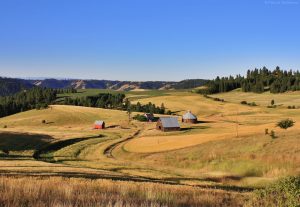
But, the summer of 2003 in Eastern Oregon was a windy one, and a couple of windstorms blew across the experimental fields, scattering HR bentgrass seed “well beyond the designated control area.” Cross-pollination with resident bentgrass was recorded as far as 13 miles away, and there was no going back.
HR creeping bentgrass took hold in the wet places of the high desert. Pretty soon local farmers began to find grass clogging their irrigation ditches that remained bright green and healthy after spraying with glyphosate, the only herbicide in their toolbox approved for use along waterways.
Scott Miracle-Gro was fined the maximum of $500,000 for losing track of their GE experiment, and was on the hook to help landowners and local weed boards deal with the mess.
Due to a loophole in the regulatory system, they were eventually able to cut a sweet deal with APHIS that released them from liability for cleaning up their mess if they agreed to never commercially release HR bentgrass. Which, as Rosen points out, is a perfect example of what critics call “glaring weaknesses in the country’s oversight of genetically engineered crops.”
GE crop regulations “haven’t changed significantly since 1987,” and agencies are not required to weight the full impact of this new tech on surrounding farms and ecosystems. This lack of oversight and scope often leads to unintended consequences, as we cover extensively here on Hygeia.
With Scott no longer financially liable, many farmers and ranches dealing with the wayward bentgrass are concerned their local weed boards or the landowners themselves will be forced to pick up the slack. The bentweed control effort is estimated to cost about $250,000 a year, money that is hard to come by in these rural counties. Local residents are raising their voices and speaking out against a regulatory system that they say is too soft of big ag.
Cross-contamination of GE crops can cause big problems for export markets, as many trading partners are not interested in GMO crops. HR creeping bentgrass hasn’t caused problems with international trade yet, but given that this problem is not going away anytime soon many are still worried about these what if questions.
This is a good read and it does an excellent job of explaining some of the main weaknesses of GE regulation in the U.S., and the impact that cross-contamination can have on farmers and farm communities. With the influx of new and “better” GE technology, it sure doesn’t seem like the last story like this we will hear.
Source:
Julia Rosen, “Escaped GMO bentgrass creates bitter divide in Eastern Oregon still,” The Oregonian, July 5, 2018.