
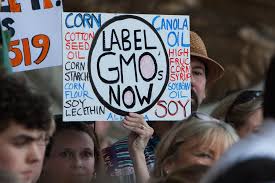
The U.S. Farmers and Ranchers Alliance is one of the well-funded, influential organizations seeking to educate the public about all-things-agricultural (albeit, mostly conventional ag). They address food and farming-related economic, trade, federal policy, conservation, food safety, biotech, and research issues. Their CEO, Randy Krotz published an opinion piece July 6, 2017 in AgriPulse, a widely read, subscription-based ag newsletter, entitled “The Non-GMO Project – Creating fake news at the grocery store.” (Disclosure — I am a subscriber and fan of AgriPulse). It beings by stating —
“Going to the grocery store has become a parallel experience to reading political opinions online – half truths, emotional visuals, and the ability to exist in an echo chamber only interacting with others just like you. This means true transparency, science and understanding is being eliminated from the consumer experience.”
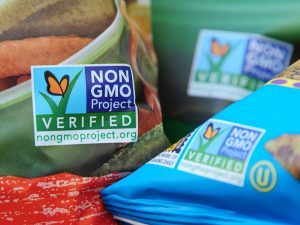
He goes on to criticize the Non-GMO Project for verifying non-GMO content in foods that are not genetically engineered, and then writes —
“The Non-GMO Project…is using its brand to fuel a business model that is based on fear and lack of information. That’s the opposite of transparency.”
He closes with this plea —
“And when I see food companies and even agriculture companies cave to the pressure to be ‘Non-GMO’ certified even when they know that symbol is not based on science or critical thinking but on emotional manipulation, my heart breaks a little.”
I have not paid a lot of attention to the PR campaigns managed by U.S. Farmers and Ranchers Alliance, but this provocative piece by its CEO could start a long-overdue dialogue. So, I added a “Comment” to Randy’s op-ed this morning on the AgriPulse website. In a nutshell and with slight editing, this is what I wrote:
Randy Krotz raises some important questions re the Non-GMO project and its verification of Non-GMO status for foods like orange juice and berry products that contain no GMO ingredients.
I served on the Non-GMO project’s technical standards committee for several years, and these issues were frequently raised and debated. To me, prior to the commercial introduction of Artic apples, e.g., it was not legit to label a fresh apple as Non-GMO, but now there is a reason to do so, whether one accepts it as justified or not.

And prior to the Artic apple coming onto the market, many foods made with apples also contain ingredients from GE corn, soybeans, or canola (applesauce, sweetened apple juice, apple pie, etc etc).
Randy Krotz criticizes the Non-GMO project for stating on its website that there is no scientific consensus on GE food safety. He says there is, and claims that dozens of reports and statements issued by governments, science organizations, and regulatory bodies support this conclusion. But actually, they do not. It is important to read fully the detailed reports put out by the NAS, the EU, the AAAS, and other scientific bodies, rather than relying just on press releases and PR statements from biotech true believers that spin what the reports say. Just might be a little fake news there.
Almost all the reports say some variation of three things: (1) there is no convincing evidence that today’s GE crops pose new or more serious food safety risks than non-GE crops; (2) new methods are needed to track subtle changes in gene expression, which could alter nutrient levels or lead to the production by plants of novel toxins or allergens; and, (3) post-commercialization monitoring in humans is warranted (never done anywhere in the world).
The above three conclusions do not equal “GE crops are safe.” Given recent science reporting unintended genetic changes in GE crops, including those produced via gene silencing techniques, anyone claiming that today and forevermore, all GE crops are safe is making a PR statement, not a scientific one. (Of course the safety of GE crops is also impacted by the pesticide residues on and in them, a point GE proponents are not eager to discuss, or even acknowledge as relevant).
Last, one of Randy’s claims tells only part of the complex story playing out on the costs/benefits of today’s major GE traits. He writes “…[farmers] choose to grow GM crops because they recognize and have experienced the environmental and sustainability benefits first hand on their own farms.”

Environmental benefits like doubling, and in the Midwest, a likely tripling of herbicide use in response to the spread of glyphosate-resistant weeds?
Sustainable, in the face of the spread of Bt resistant insects in every part of the world where Bt corn and cotton have been widely planted? Sustainable economically for farmers, who are paying 2-X to 3-X for seed, and way more for herbicides, in “technology packages” that don’t really work anymore, and require more and more “support” (i.e., more pesticide, more traits) year to year?
There are pros and cons of GE crop technology, and both arise in large part from how the technology is used. I hope farm organizations and ag advocates will recognize the need to acknowledge the downsides of how first-generation GE technology has been used, because without doing so, the road ahead for next-generation GE technology will likely be no smoother, and organizations like the Non-GMO project will thrive and grow.
Source:
Randy Kratz, “The Non-GMO Poroject- Creating fake news at the grocery store,” AgriPulse, published online July 6, 2017.