
Guest Blog
Note to Readers: In May 2017, a series of messages were posted on organic_ipm@googlegroups.com and the e-list for the Northeastern IPM Center (see the Join the Conversation link on the top right of this News and Information page). Fred Kirschenmann of Stone Barns Center for Food and Agriculture and the Leopold Center for Sustainable Agriculture contributed two posts on the essential features of sustainable and organic production systems, in contrast to specialized, homogeneous conventional systems.
With Fred’s permission, a lightly edited version of his two, sequential posts follow as a Hygeia Analytics guest blog.
By: Fred Kirschenmann
One of the key issues missing in this particular description of the integration [of farming practices] is the emphasis on “control,” while the core concept of Integrated Pest Management (IPM) is “integration,” and the core concept underlying organic agriculture is the concept of managing a farming system like an “organism.”
We now know from a long history of experimentation that biodiversity and soil health are two key components of pest management systems minimally dependent on external “control” inputs. I now see this demonstrated again, today, by Jack Algiere at Stone Barns, where aggressive soil health management and very diverse rotations of various fruits and vegetables has eliminated totally the need for any pesticide “control” inputs.
I have also seen this on my own farm in North Dakota where, in our organic grain and livestock operation, we have not applied ANY kind of pesticide inputs since we converted the farm to organic in 1976. Nature IS self-regulating and self-renewing when we use nature’s own principles – an approach which is, from my perspective, fundamentally what “integrated” pest management (IPM) is all about.
I am not suggesting that we can get there all at once, but this should be our long-term goal—the elimination of external, pest “control” inputs, and the adoption of “integrated,” biological-based, self-regulating pest management systems. The use of “natural” pesticides should only be an interim strategy, while we develop the integrated, biodiverse systems that become possible in conjunction with truly healthy soils.
We should also keep in mind that there are farmers out there today who are not even “organic,” but who are already managing to achieve these input-eliminating farming methods. For several inspiring examples, see David Montgomery’s new book, Growing a Revolution.
Mindful Transition
In response to questions about the transition to organic farming on my farm in North Dakota, I did just quit using external inputs — fertilizers or pesticides, but I am not suggesting that everyone can, or should try to do that. As always, a lot depends on the system and the circumstances.
Originally, I followed the advice of David Vetter — my mentor – who recommended that we NOT “convert the whole farm at once.” So, we originally converted 1/3 of the farm. It happened to be an unusual year—temperatures were perfect for early crop emergence, rainfall was spread out perfectly, etc.
There was absolutely no difference in yields and pest problems between the 1/3 of the farm that was in transition and the 2/3 that remained in conventional. So I thought, well, this transition thing is not going to be a problem, and I decided to convert the whole farm in the second year of the process. That was a mistake, since the following two years were far from “perfect” transition years. AND, we had not yet figured out an appropriate crop rotation in our ecological neighborhood!
It took us several years to work everything out. However, what I learned led me to understand (again in our ecological neighborhood) that with the right kind of transition strategy, it WOULD be possible to make the transition without continuing to use pesticides — although I would probably continue to use modest amounts of permitted fertilizers, until the health of the soil was restored.
Adopting the right kind of diverse rotation is, of course, an essential step in the transition process. If a conventional farmer is raising monoculture corn and soybeans and wants to transition to grow just these two crops organically, then, that farmer will face an entirely different set of challenges—and probably can NEVER transition to a truly organic system. The best he/she can hope for is what is often called an “industrial” organic system — one that simply relies on “natural” inputs instead of synthetic inputs.
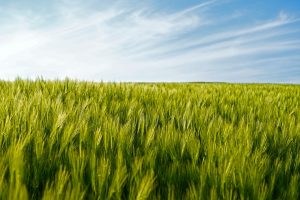
In any case on our farm, which is a small grain livestock farm in the prairie pothole region of North Dakota, a cropping system that works well without any external inputs is three years of alfalfa (a deep rooted, leguminous, perennial crop), followed by flax (a cool season annual that requires a relatively weed-free environment and little nitrogen), followed by hard red spring wheat (another cool season annual, a grassy plant, that does require more nitrogen), followed by winter rye (a fall seeded biannual and great weed suppressant), followed by buckwheat, (a warm season, broad leaf plant) with alfalfa inter-seeded, which then goes back to the three years of alfalfa.
The alfalfa is used to feed the livestock during the winter months. The animal manure and straw that piles up during the winter months is the raw material needed to make compost, which is applied at the end of the alfalfa cropping period to sustain soil fertility and enhance soil health.
It is this complex, interactive system that has made it possible for us to maintain appropriate yields and prevent pest emergence and damage, at least in most years, on most fields. It is what I would call a radical version of IPM. This system is well adapted to the prairie pothole region ecology, but not likely suitable to a bioregion in California or Florida. IPM designs always have to be adapted to the natural ecologies of the place.
The basic philosophy on which organic farming system success depends is “biomimicry,” a concept articulated so clearly by Janine Benyus, as opposed to the “control” nature strategy that has dominated our industrial culture and defined technological “progress” on the farm over the last half century.